

Key insight - the CFSS must form part of a multi-system, best practice response to domestic, family and sexual violence that addresses the experience of victim-survivors, children as victim-survivors, and dads and men who use violence.
Family complexity assessments undertaken by the CFSS Pathways Service are showing that 57% of families have experienced current or active domestic or family violence concerns.
CFSS Referrals for Intensive Family Services 2024 – 2025
Text description of graphic: CFSS Referrals for Intensive Family Services 2024 – 2025
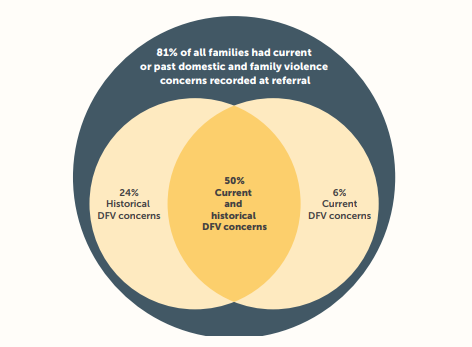
The image is a Venn diagram illustrating the proportion of families referred to CFSS IFS in 2024 – 2025 who had domestic and family violence (DFV) concerns recorded at referral.
Overall finding
81 percent of all families referred to CFSS had either current, historical, or both types of DFV concerns.
Breakdown of the 81 percent
The Venn diagram divides this group into three categories:
- Historical DFV concerns only
- 24 percent of families
- these families had past domestic or family violence concerns, but no current concerns recorded at the time of referral.
- Current DFV concerns only
- 6 percent of families
- these families were experiencing domestic or family violence at the time of referral, with no history of DFV recorded.
- Both current and historical DFV concerns
- 50 percent of families
- these families had a history of DFV and were also experiencing current DFV issues.
We know that CFSS IFS are currently one of the only services that work with families when there is ‘active’ domestic or family violence in the home.
1 in 3 families referred to CFSS IFS with current DFV concerns reported living with alleged perpetrators in the home. 1
The CFSS data and learning approach was highly informative in the Royal Commission into Domestic, Family and Sexual Violence and was recognised in the final report.
Reference list
- CFSS Data (2025), Analysed by EIRD, Child and Family Support, Department of Human Services, South Australian Government