

Key insight - family complexity is not associated with better or worse engagement outcomes. It is the engagement strategies we use and effective supervision that makes a difference.
Once a referral is allocated to a CFSS Intensive Family Services (IFS) practitioner, engagement rates measure whether the practitioner is successful in getting initial agreement from the family to continue to work with them.
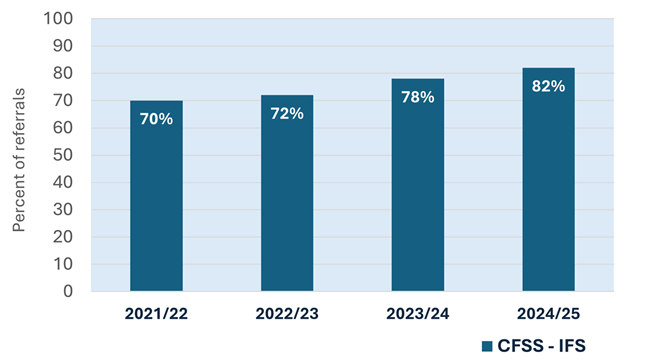
Our data shows the overall engagement across all CFSS IFS has increased from 70% in 2021– 2022 to 82% in 2024 – 2025.1
CFSS - Intensive Family Services (IFS) engagement rates by year
Allocated IFS referrals successfully engaged in service provision (percent) by year, 2021– 2022 to 2024 – 2025.
Text description of chart: CFSS - IFS engagement rates by year
Chart title: CFSS - IFS engagement rates by year
Description: A bar chart shows the percentage of allocated CFSS Intensive Family Support (IFS) referrals that successfully engaged with the service over four financial years. Engagement rates increase steadily each year.
Data shown in chart:
For the financial year 2021 to 2022 the engagement rate was 70 percent.
For the financial year 2022 to 2023 the engagement rate was 72 percent.
For the financial year 2023 to 2024 the engagement rate was 78 percent.
For the financial year 2024 to 2025 the engagement rate was 82 percent.
Overall insight: Engagement rates increased from 70 percent in 2021– 2022 to 82 percent in 2024 – 2025, showing a positive upward trend in successful family engagement with CFSS IFS.
What this data tells us about engagement approaches
CFSS data is also providing new insight into the engagement approaches used by practitioners and which strategies can lead to increased engagement with different types of families.
Our data is clearly showing that family complexity is not associated with better or worse engagement outcomes. It is the engagement strategies we use and effective supervision that makes the difference.
The use of assertive engagement strategies has been shown to increase the likelihood of successful engagement by up to fifty percent.1
These assertive engagement strategies include face-to-face contact, organising goods and services and partnering with schools.
However, these strategies only explain part of the picture. We are learning that other practice elements, such as clinical and cultural governance, may also play a significant role in shaping engagement outcomes. These areas are less well understood and require further exploration to strengthen the system’s ability to support children and families effectively.
Our ongoing learning about engagement approaches is helping us to drive consistency in skills and confidence of CFSS practitioners in working effectively with families presenting with higher safety risks and complexity.
Reference list
- CFSS Data (2025), Analysed by EIRD, CFS, DHS, SA Government