
Download print version:
Strategy at a glance
The Strategy provides an overarching framework, outlining how DHS will identify and remove barriers that affect Aboriginal and Torres Strait Islander employment opportunities, staff retention, cultural safety, professional development and career progression.
DHS and the Executive Leadership Team (ELT) are committed to ensuring that Aboriginal people can secure ongoing employment and establish a sustainable and successful career within the department. The commitment is further supported by our third Innovate Reconciliation Action Plan (RAP), which strengthens the link between the Strategy and our commitments to Closing the Gap.
DHS aims to work towards an Aboriginal employment target of 7% by the final year of the Strategy.
To work towards accomplishing this goal, the Strategy outlines five key focus areas:
- Recruitment and employment pathways
- Career development and retention
- Senior leadership and succession pipeline
- Increased cultural knowledge and competence of our non-Aboriginal workforce
- Wellbeing and cultural safety
DHS acknowledges that a lot of work needs to be done to build on the focus areas to achieve quality outcomes and genuinely transform this agency. There are significant differences in current representation between DHS Divisions, with some having very low to no representation of Aboriginal staff. The Workforce Strategy sets out a range of initiatives to address these imbalances and further increase representation across divisions and directorates.
Ahead of implementation, a process to support responsible parties to monitor and report on action implementation will be developed.
I am pleased to launch the DHS Aboriginal Workforce Strategy 2026–2031 (the Strategy).
Our new Strategy forms part of DHS’ ongoing commitment to Reconciliation and our responsibilities under Closing the Gap. Led by Aboriginal staff, the Strategy builds on the important progress and achievements made through our previous DHS Aboriginal Workforce Strategy 2021–2023 where we:
- exceeded our Aboriginal employment target of four per cent
- increased the support of our existing Aboriginal employees by re-developing and re-invigorating our Nunga Network for Aboriginal staff to come together on a regular basis to support each other.
Over the next five years our key focus areas will be:
- Recruitment and employment pathways
- Career development and retention
- Senior leadership and succession pipeline
- Increased cultural knowledge and competence of the non-Aboriginal workforce
- Wellbeing and cultural safety.
As we work towards fulfilling the aspirations set out in this Strategy, Aboriginal staff will be central to the roll-out of the actions outlined in our plan. But as allies our role is also to ensure that we value and learn from Aboriginal staff’s lived-experience, cultural knowledge and right to self-determination, as together we create a more equitable future.
Ngaityalya (Kaurna, thank you)
Sandy Pitcher (she/her)
DHS Chief Executive
Acknowledgement of Country and Traditional Owners
The Department of Human Services (DHS) acknowledges and respects Aboriginal people as the state’s first people and recognises Aboriginal people as traditional owners and occupants of lands and waters in South Australia.
We acknowledge that the spiritual, social, cultural and economic practices of Aboriginal people come from their traditional lands and waters, and that the cultural and heritage beliefs, languages and lore are still of importance today.
We are committed to ensuring that the needs and aspirations of Aboriginal people are incorporated in the design, development, monitoring and evaluation of deliverable actions.
Contributors’ acknowledgment
The DHS Aboriginal Workforce Strategy 2026–2031 acknowledges the efforts of the following teams who contributed to its development:
- DHS Aboriginal and Torres Strait Islander staff
- Nunga Network Leadership Group
- Organisational Development and Learning
- Closing the Gap Policy and Transformation
- Inclusion Policy and Reform
- Office of the Chief Executive and Governance.
Terminology
DHS respectfully uses the terminologies ‘Aboriginal and Torres Strait Islander’ and ‘Aboriginal’ in this strategy to refer to the Aboriginal and Torres Strait Islander peoples of South Australia. This is not intended to exclude Torres Strait Islander people, or people who may identify as being of both Aboriginal and Torres Strait Islander descent. We acknowledge that other Aboriginal and Torres Strait Islander cultural names may be preferred.
‘Cultural Maintenance’ by Allan Sumner
The artwork was commissioned by DHS from Allan Sumner, a descendant of the Ngarrindjeri, Kaurna, and Yankunytjatjara people, to represent its vision for reconciliation.
The artwork is a fusion of symbols that reflect the ways in which DHS serves the people and communities of South Australia. It visually pieces together these symbols, in waveform, to represent the cohesion and connectedness within DHS.
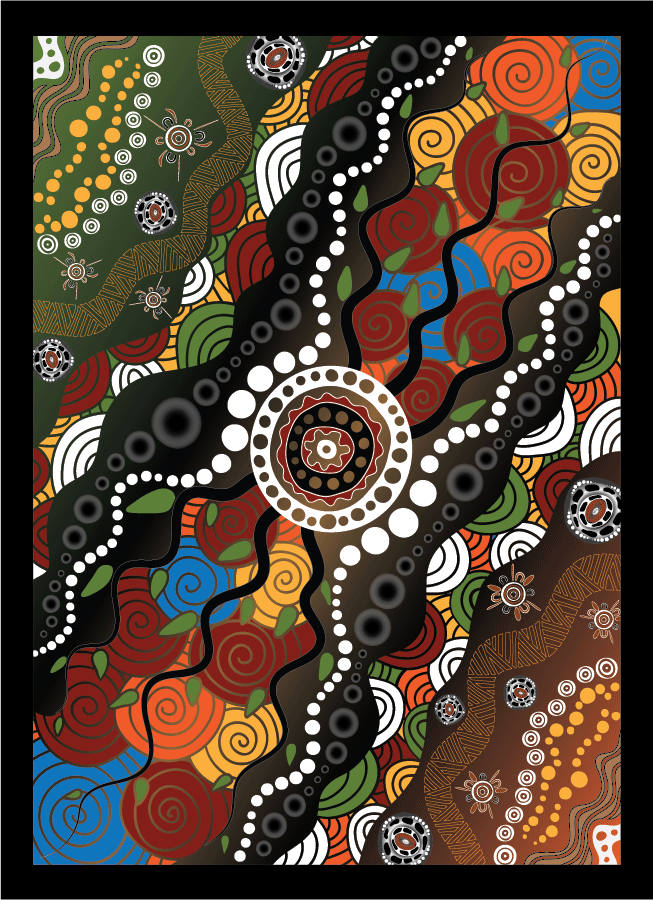
Explanation of artwork symbols

Protection
The same ways and naturally protects against erosion, we must also protect and maintain our cultures, languages and values.

Growth and Self-development
A living tree that is being sustained by water. Like the tree, DHS provides opportunity for personal growth and self-development.

Innovation
A tree root growing under the ground, and winding its way around obstacles on its journey, creating new paths as it grows bigger and stronger.

Accountability
Two journey lines represent Aboriginal Elders who are responsible for teaching our young ones and leading them on the right path. Their approach may not be the same, but their message is consistent.

Support
Gathering sites; places where support is offered to families and communities that is culturally safe.

Collaboration
A woven pattern found in traditional basket weaving represents working together for a strong, collective solution. The strands weave together, forming a robust, functional basket.

Sustainability
Water and freshwater springs representing the flow of life, renewal and how water sustains life in cycles spanning generations.

Inclusiveness
The coming together of health professionals, providing collaborative opportunities for people to learn about health issues for Aboriginal people.

Culture
Aboriginal identity is our culture — it is our home and our comfort, our safe place. This symbol represents shelter and the cultural collective of Aboriginal community groups across South Australia.

Women/Men Teaching Families
Teaching young people and passing on First Nations knowledge.
Aboriginal Workforce Strategy 2021–2023
This strategy built on previous Aboriginal employment strategies to recruit and retain Aboriginal people and to develop career pathways for leadership aspirations and increase cultural knowledge and competency of non-Aboriginal staff.
Safer Family Services Aboriginal Cultural Practice Framework
The Safer Family Services Aboriginal Cultural Practice Framework articulates Aboriginal ways of ‘knowing, being and doing’. It is designed to consolidate this knowledge and skill base in an organisational context and in doing this, acting as a resource and best practice guide.
DHS Innovate Reconciliation Action Plan (RAP) April 2022–March 2024
The DHS Innovate RAP has achieved many actions with great results. The next edition of Innovate RAP will continue to achieve actions and work towards progressing to a Stretch RAP.
Aboriginal Recruitment Guide
The department’s Aboriginal Recruitment Guide has been designed to provide practical support for DHS staff involved in the recruitment and selection of Aboriginal people by incorporating best practice employment principles.
Our vision
The Strategy provides a strategic framework for DHS to achieve our vision of becoming an employer of choice for Aboriginal people and supporting Aboriginal staff and clients.
The Strategy will guide DHS staff to:
- create a culturally safe environment, in which Aboriginal staff are valued for their cultural knowledge and lived experiences
- ensure that our frontline service delivery to our communities includes the contributions of Aboriginal staff and the best cultural delivery practices in the interests of continuous improvement
- continue to develop capability and leadership opportunities to strengthen employment pathways and increase the Aboriginal workforce, ensuring Aboriginal staff are supported across DHS to achieve positive work life balance.
This will be achieved through effective recruitment processes, culturally safe and supportive workplace cultures, opportunities for professional development and mentoring, and demonstrated respect for the skills, expertise, and perspectives of Aboriginal employees.
Closing the Gap
The National Agreement on Closing the Gap (National Agreement) requires all governments to change the way they work with and for Aboriginal people to overcome inequality and achieve life outcomes equal to all Australians. At the centre of the National Agreement are four Priority Reforms that focus on changing the way governments work with Aboriginal people.
They are:
- Priority Reform 1: Formal Partnerships and Shared Decision Making
- Priority Reform 2: Building the Community-Controlled Sector
- Priority Reform 3: Transforming Government Organisations
- Priority Reform 4: Shared Access to Data and information at a Regional Level.
The National Agreement also has 19 Targets across 17 Socio-Economic Outcome areas (SEOs) that have an impact on life outcomes for Aboriginal people. For South Australia, DHS has lead responsibility for two SEOs and co-leads a third with the Department for Child Protection (DCP):
- SEO 11: Aboriginal young people are not overrepresented in the criminal justice system
- SEO 12: Aboriginal young people are not overrepresented in the child protection system (co-led with DCP)
- SEO 13: Aboriginal families and households are safe.
In December 2024, the South Australian Government published Closing the Gap - South Australia’s Implementation Plan 2024–2026 (Implementation Plan).
The Implementation Plan builds on the previous Plan and sets out what actions will be taken to achieve the National Agreement’s Priority Reforms and SEOs. Of the actions contained in the Implementation Plan, DHS leads 30 and shares responsibility for the remaining 30 with other government agencies. Annual updates on all actions will be published in South Australia’s Annual Report – National Agreement on Closing the Gap.
Alongside our 60 Implementation Plan actions, DHS is committed to transforming the way it works to deliver on Closing the Gap (CtG). This includes:
- transforming our systems and structures to improve accountability and better respond to the needs of Aboriginal people
- developing new ways of working in partnership with Aboriginal people to accelerate policy and place-based progress on CtG
- building the ACCO sector to deliver high quality services that meet the needs of Aboriginal people.
View the Closing the Gap SA’s Implementation Plan 2024 – 2026: agd.sa.gov.au/aboriginal-affairs-and-reconciliation/closing-the-gap/south-australias-implementation-plan.
Cultural Safety
Cultural Safety is about overcoming the power imbalances of places, people and policies that occur between the majority non-Indigenous position and the minority Aboriginal people so that there is no assault, challenge or denial of the Aboriginal person’s identity, of who they are and what they need.
Cultural Safety is met through actions from the majority position which recognise, respect, and nurture the unique cultural identities of Aboriginal people. Only the Aboriginal person who is the recipient of a service or interaction can determine whether it is culturally safe.
DHS is strongly committed to having a culturally safe work environment by developing cultural supervision for management and supporting Aboriginal staff to:
- attend regular Nunga Network meetings and be empowered by the Nunga Network Leadership Group
- access cultural leave to participate in cultural obligations and community responsibilities, offering cultural leave days through Special Leave with Pay provisions
- access support from the Principal Aboriginal Workforce Consultant
- participate in Aboriginal Staff Forums.
DHS Aboriginal Workforce
DHS set a target to increase Aboriginal employment to 4%. This has been achieved with the current Aboriginal employment rate of 4.2%.
Aboriginal employment rate
Year on year, DHS has increased the Aboriginal employment rate:
- 2021: 3%
- 2022: 3.6%
- 2023: 3.7%
- End of June 2024: 4.2%.
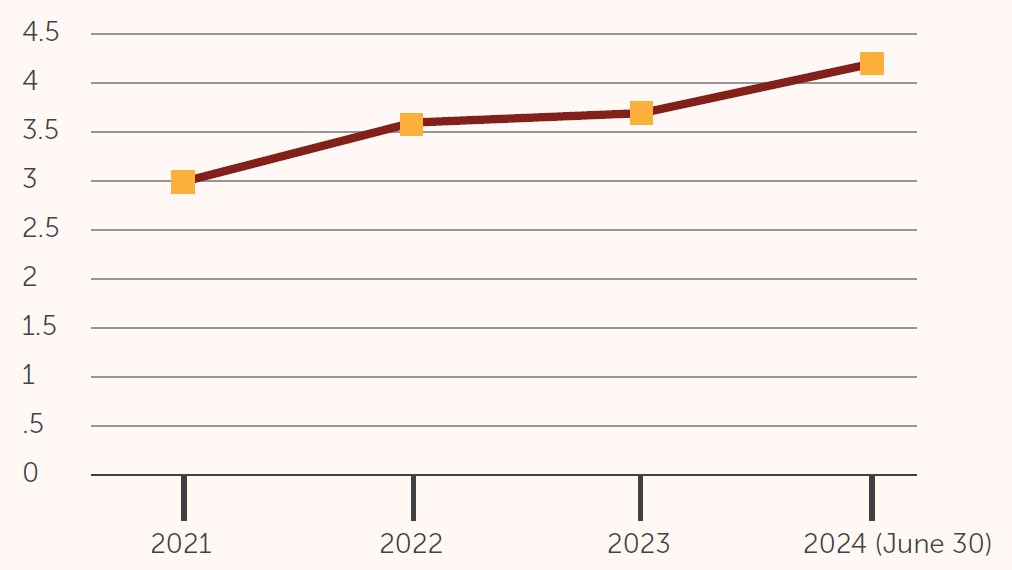
Figure 1: Percentage of DHS Aboriginal Workforce (source: CHRIS21 - 30 June 2024).
As of 30 June 2024, DHS had a total workforce of 3,286 staff members, with 138 staff identifying as Aboriginal (4.2% of workforce).
Of those 138 Aboriginal staff, there were 102 (73.9%) females and 36 (26.1%) males.
There were 19 casual positions, 73 ongoing positions and 46 term contract positions across the department.
Classification range
The classification range of Aboriginal staff was:
- ASO: 46
- AHP: 45
- OPS/X: 21
- INT: 11
- DIS: 9
- MAS: 2
- TRA: 2
- SAES: 1
- WSE: 1.
Percentage of Aboriginal staff in divisions (Source: Chris21, 30 June 2024).
Total percentage of Aboriginal staff is 4.2% (138 staff).
- Decommissioned Units: 16.70%
- Child and Family Support: 14.3%
- Community and Aboriginal Partnerships: 13.3%
- People and Performance: 5.80%
- Inclusion Support and Safeguarding: 3.3%
- Office of the CE and Governance: 3.07%.
- Disability Services: 0.79%
- Finance and Business Services: 0.64%
Table 1. Numbers of the percentage of Aboriginal staff in divisions (Source: Chris21, 30 June 2024).
| Division | Total number of all DHS staff | Total number of Aboriginal staff | Aboriginal staff by % |
|---|---|---|---|
| Child Safety and Family Support | 307 | 44 | 14.3 |
| Community and Aboriginal Partnerships | 384 | 51 | 13.3 |
| Decommissioned Units | 6 | 1 | 16.7 |
| Disability Services | 1641 | 13 | 0.79 |
| Finance and Business Services | 155 | 1 | 0.64 |
| Inclusion Support and Safeguarding | 659 | 22 | 3.3 |
| Office of the Chief Executive and Governance | 65 | 2 | 3.07 |
| People and Performance | 69 | 4 | 5.8 |
| Total | 3286 | 138 | 4.2 |
The need to focus on the Aboriginal Workforce
Evidence shows that increasing Aboriginal economic participation is fundamental to achieving sustained improvement across a range of indicators in education, employment, health and justice.
Economic independence enhances the sustainability and viability of South Australian Aboriginal communities. It also increases Aboriginal employment, supports a more vibrant business sector, and encourages more investment and innovation across South Australia – South Australian Government Aboriginal Action Plan 2019–2020.
The gap between Aboriginal and non-Aboriginal South Australians on every measurable indicator is too wide. Aboriginal people do not experience the same levels of prosperity or outcomes in health, education, and employment.
It is incumbent on those who can effect positive change for Aboriginal people to do so.
DHS is committed to employing more Aboriginal staff, retaining and upskilling current Aboriginal staff and creating a culturally safe working environment to make our department an employer of choice for Aboriginal people.
Employment of Aboriginal people in the public sector has been directly linked to many benefits, including:
- improved access and outcomes for clients
- increased cultural competency of service delivery, and
- better collaboration between government and Aboriginal people.
To achieve these benefits, DHS must set firm targets. We must hold ourselves accountable and ensure that we consistently monitor and work to achieve our targets.
Looking across South Australian Government strategies, it is clear that ensuring Aboriginal staff have opportunities to lead in senior roles, building and developing Aboriginal employee networks, committing to Reconciliation Action Plans, working toward cultural competence, providing Human Resource (HR) support, and having connection to agency priorities, increases the representation of Aboriginal peoples at all classification levels.
The importance of empowering Aboriginal staff
The importance of empowering Aboriginal staff is vital to achieving improved service delivery outcomes for the community. This can only be achieved with successful career progression and employment stability.
This Strategy provides DHS with strong, practical ways to empower Aboriginal staff in more effective ways, which have been developed after much learning and reflection.
Empowering Aboriginal staff is essential to creating an inclusive and culturally responsive workforce. By providing opportunities for leadership, professional development, and ensuring Aboriginal voices are heard, we not only foster diversity but also enhance organisational effectiveness within DHS. This approach in empowering Aboriginal staff promotes cultural competence and cultural safety, encourages innovative perspectives and supports the wellbeing and retention of Aboriginal employees, contributing to a stronger and more resilient workforce. Empowering Aboriginal staff also strengthens community connections and upholds our commitment to reconciliation and equality.
Key elements to work towards a prosperous future:
- Culture at the heart
- Supporting and promoting culture
- Building DHS’s cultural responsiveness
- Reshaping DHS services and systems to work with culture
- Walking together
- Truth-telling
- Eliminating racism and promoting Aboriginal culture
- Strengthening DHS accountability
- Reviewing and improving policy, procedures and practises
- Listening and learning from Aboriginal people.
The Nunga Network Leadership Group was established in August 2024 to provide support for the Nunga Network and to escalate issues of concern to the relevant Executive Leadership Subcommittee(s).
The Nunga Network Leadership Group consists of Aboriginal staff members from across the department, with gender balance of co-chairs. This is a new initiative that the department sees as a leadership aspiration and to have a formal mechanism in place to ensure Aboriginal staff members are valued and listened to.
The Strategy prioritises and incorporates the strong voices of Aboriginal staff to highlight opportunities for workforce improvement and the issues that are most important to the DHS Aboriginal workforce.
Aboriginal staff have clearly expressed the changes needed for DHS to become a Culturally Safe department, one that values the knowledge and expertise of Aboriginal staff.
To create a Culturally Safe, respectful and thriving Aboriginal employment journey within DHS, some of the key areas for change highlighted within the Strategy are:
- Governance and genuine shared decision-making
- Truth-telling and accountability
- Wellbeing and Cultural safety
- Embedding Aboriginal business in the structure of DHS to enable systemic change
- Lateral love
- Respect and deep listening.
This Strategy has been carefully designed and collectively endorsed by the Nunga Network Leadership Group and its Co-Chairs.
The Strategy will operate until December 2031 and be reviewed annually to ensure actions and targets are progressing or achieved and aligned with Closing the Gap and Innovate Reconciliation Action Plan, 2026–2028.
To assist business units in driving each action that they are responsible for in the Strategy and to ensure progress is being achieved, a monitoring and reporting process will be developed.
The Strategy outcomes and achievements will be reported annually to the Executive Leadership Team Committee, and quarterly to the Aboriginal Outcome Executive Committee, Nunga Network Leadership Group.
Updates on the implementation of the Strategy will occur through the Executive Leadership Team to ensure its continued progress and success.
What we’re going to do
Action delivery will be monitored and reported quarterly to relevant executive committees to ensure progress on all actions is being achieved and to seek any further recommendations and resources required to achieve positive outcomes.
The 5 Key Focus Areas are:
- Recruitment and employment pathways
- Career development and retention
- Senior leadership and succession pipeline
- Increased cultural knowledge and competence of non-Aboriginal workforce
- Wellbeing and cultural safety.
Key Focus Area 1: Increase employment opportunities and pathways for Aboriginal people and extend visibility and representation across all Divisions, Directorates and Senior Leadership.
1.1 Increase Aboriginal employment
Action: Increase Aboriginal employment across all levels, with a focus on Divisions below 4%.
Measurable Target: Year-on-year growth in Aboriginal workforce, including increased representation in low-performing areas.
Responsibility:
- Executive Directors
- Directorates
- Organisational Development and Learning
- Reconciliation Action Plan.
Timeframe: 5 Years.
1.2 Strengthen early career pathways
Action: Strengthen early career and study-linked pathways through traineeships and cadetships.
Measurable Target: Number of trainees/cadets and retention/completion rates.
Responsibility:
- Organisational Development and Learning
- Business Units.
Timeframe: 5 Years.
1.3 Expand culturally safe recruitment
Action: Expand and promote culturally safe and visible recruitment practices, including use of the Aboriginal Employment Register and Aboriginal-specific media.
Measurable Target: Increased Aboriginal applications and placements via targeted channels.
Responsibility:
- Organisational Development and Learning
- People and Partnerships Business Units Reconciliation Action Plan.
Timeframe: 5 Years.
1.4 More permanent Aboriginal identified roles
Action: Ensure all Aboriginal identified roles are designed, advertised, and structured appropriately — and move toward permanency.
Measurable Target: Increase in applications, quality of role descriptions, and number of ongoing positions.
Responsibility:
- Organisational Development and Learning
- Business Units
- People and Partnerships Reconciliation Action Plan.
Timeframe: 2 Years.
1.5 Establish a recruitment support framework
Action: Establish an Aboriginal recruitment support framework including panel participation, selection training, and internal promotion pathways.
Measurable Target: All identified roles have Aboriginal panel members; internal opportunities promoted via Nunga Network.
Responsibility:
- Directors
- Business Units
- Organisational Development and Learning
- People and Partnerships
- Nunga Network.
Timeframe: 5 Years.
1.6 Better data on recruitment and retention
Action: Improve culturally safe recruitment and retention through audits, exit feedback, and mandatory manager training.
Measurable Target: Audit findings actioned; exit data tracked; manager PDPs include Aboriginal-specific learning.
Responsibility:
- Business Units
- People and Partnerships
- Reconciliation Action Plan.
Timeframe: 3 Years.
Key Focus Area 2: Retain existing Aboriginal staff by embedding culturally appropriate workplace practices and support systems.
2.1 Career development
Action: Provide career development support for Aboriginal staff, including workshops, acting opportunities, and study pathways.
Measurable Target: Workshop participation, acting opportunity uptake, and number of employees supported through study leave and fee reimbursement.
Responsibility:
- Business Units
- Organisational Development and Learning
- People and Partnerships.
Timeframe: 5 Years.
2.2 Individualised development
Action: Promote and maintain individualised development planning for all Aboriginal staff.
Measurable Target: All PDPs are up to date and reflect career aspirations.
Responsibility:
- Business Units
- Organisational Development and Learning.
Timeframe: 5 Years.
2.3 Strengthen Aboriginal leadership and peer support
Action: Strengthen Aboriginal leadership and peer support through Indigenous mentoring, forums, and Nunga Network coordination.
Measurable Target: Course completion numbers, forum participation, and Nunga Network engagement.
Responsibility:
- Executive Leadership Team
- Business Units
- Organisational Development and Learning
- Nunga Network Leadership Group.
Timeframe: 5 Years.
2.4 Better Aboriginal workforce data
Action: Track Aboriginal workforce data, exit trends and movement to support evidence-based decision-making and retention.
Measurable Target: Annual workforce profile data, exit interview analysis, and reported improvements.
Responsibility:
- Organisational Development and Learning
- People and Partnerships
- Workforce Development and Integrity.
Timeframe: 5 Years.
2.5 Improved cultural capability for managers
Action: Build cultural capability of managers through development resources and support for cultural leave.
Measurable Target: Manager PDPs include cultural capability; increased uptake and support for cultural leave.
Responsibility:
- Business Units
- Organisational Development and Learning
- People and Partnerships.
Timeframe: 3 Years.
Key Focus Area 3:Support and develop our existing Aboriginal staff and improve career planning and training to build capabilities, enhance opportunities and create a stronger succession pipeline into senior leadership roles.
3.1 Build a visible Aboriginal succession pipeline
Action: Build and embed a visible Aboriginal succession pipeline across DHS Divisions.
Measurable Target: Improved leadership pathways and development opportunities; increased promotion rates; career data published.
Responsibility:
- Executive Leadership Team
- Business Units
- Organisational Development and Learning
- People and Partnerships.
Timeframe: 5 Years.
3.2 Aboriginal participation in formal leadership programs
Action: Actively support Aboriginal participation in formal leadership programs, including Office of the Commissioner for Public Sector Employment (OCPSE), Institute of Public Administration Australia (IPAA) and SA Leadership Academy.
Measurable Target: Program completions and target allocations met; supported through PDPs
Responsibility:
- Executive Leadership Team
- Business Units
- Organisational Development and Learning
- People and Partnerships.
Timeframe: 5 Years.
3.3 More internal development opportunities
Action: Expand internal development opportunities including acting roles, mentoring, cultural supervision, and Certificate IV training.
Measurable Target: Participation rates in acting and mentoring programs; number of Certificate IV completions.
Responsibility:
- Business Units
- Organisational Development and Learning
- People and Partnerships.
Timeframe: 5 Years.
3.4 Leadership opportunities
Action: Embed cultural and professional development through structured PDPs, temporary higher duties, and executive-level exposure.
Measurable Target: Leadership experience and development reflected in PDPs; increased number of staff acting in higher roles; participation in Executive Committees and Nunga Network Leadership Group (NNLG).
Responsibility:
- Executive Leadership Team
- Directors
- Organisational Development and Learning.
Timeframe: 5 Years.
3.5 Leadership learning
Action: Embed leadership learning in Nunga Network activity and build a pipeline of future Aboriginal leaders.
Measurable Target: NNLG membership growth; facilitated learning sessions delivered and tracked.
Responsibility:
- Organisational Development and Learning
- Nunga Network Leadership Group.
Timeframe: 5 Years.
3.6 Better data on Aboriginal leadership progression
Action: Track, report and publish Aboriginal leadership progression in line with Anti-Racism and equity commitments.
Measurable Target: Career pathway data published annually; improvements aligned with the OCPSE Anti-Racism Action Plan.
Responsibility:
- Organisational Development and Learning.
Timeframe: 5 Years.
Key Focus Area 4: Build a more inclusive workforce where Aboriginal staff and culture are acknowledged, valued and respected.
4.1 Whole-of-DHS cultural learning framework
Action: Implement a whole-of-DHS cultural learning framework for all staff, supported by tailored online, in-person and role-specific learning.
Measurable Target: Framework delivered across all Directorates; participation in mandatory and specialised cultural learning tracked.
Responsibility:
- Executive Directors
- Organisational Development and Learning
- Reconciliation Action Plan.
Timeframe: 5 Years.
4.2 Strengthen cultural capability in leadership
Action: Strengthen cultural capability in leadership through immersion experiences, executive training, and participation in relevant secondment programs.
Measurable Target: Number of leaders participating in immersion training, yarning circles and secondment programs.
Responsibility:
- Executive Leadership Team
- Organisational Development and Learning
- Nunga Network Leadership Group
- Reconciliation Action Plan.
Timeframe: 5 Years.
4.3 Promote cultural visibility
Action: Promote and support cultural observance and visibility, including Aboriginal events, language, and stories across all DHS sites.
Measurable Target: Staff participation in cultural events; increased Aboriginal language use; number of promotional stories published.
Responsibility:
- Executive Leadership Team
- Business Units
- Communications and Engagement
- Reconciliation Action Plan.
Timeframe: 5 Years.
4.4 Transform digital learning
Action: Review and transform existing digital learning to Culturally Responsive Learning and embed annual participation for service delivery teams.
Measurable Target: Transition completed; service team completions tracked and reported annually.
Responsibility:
- Organisational Development and Learning.
Timeframe: 5 Years.
4.5 Cultural learning from ACCOs and Aboriginal businesses
Action: Strengthen engagement with Aboriginal Community-Controlled Organisations (ACCOs) and Aboriginal businesses to deliver tailored cultural learning and community-led training.
Measurable Target: Number of sessions delivered by ACCOs / Aboriginal providers.
Responsibility:
- Organisational Development and Learning
- Reconciliation Action Plan.
Timeframe: 5 Years.
4.6 Embed cultural responsibility in systems and policies
Action: Embed cultural responsibility in DHS systems and policies — including frameworks, protocols, and inclusive practices.
Measurable Target: Development and implementation of Cultural Responsiveness Framework, Community Engagement Framework, 26 January guidance, and Acknowledgement of Country protocols.
Responsibility:
- Aboriginal Outcomes Executive Committee
- Organisational Development and Learning
- Business Units
- People and Partnerships Communications and Engagement
- Reconciliation Action Plan.
Timeframe: 5 Years.
4.7 Better data on incidents of racism
Action: Monitor, respond to, and report on incidents of racism with appropriate cultural support.
Measurable Target: Annual ELT report; improvement actions implemented.
Responsibility:
- Aboriginal Outcomes Executive Committee
- Organisational Development and Learning
- People and Partnerships
- Reconciliation Action Plan.
Timeframe: 2 Years.
Focus Area 5: Investigate appropriate measures to prevent cultural load for Aboriginal staff and embed into practice.
5.1 Better data on cultural load
Action: Recognise and monitor cultural load and wellbeing of Aboriginal staff, including in PDPs, exit data, and wellbeing surveys.
Measurable Target: Cultural load included in all PDPs; voluntary turnover due to cultural issues under 5 per cent; wellbeing indicators tracked in exit interviews, Teamgage, GovSafety, Human Resources and Incident Management Unit systems.
Responsibility:
- Business Units
- Organisational Development and Learning
- People and Partnerships.
Timeframe: 5 Years.
5.2 Proactive cultural safety measures
Action: Embed cultural safety through proactive measures, reporting, policy awareness, and accountability across the organisation.
Measurable Target: Reduction in reports of cultural harm (<2%); cultural safety embedded in onboarding and communication; reporting and awareness systems in place.
Responsibility:
- Business Units
- Organisational Development and Learning
- People and Partnerships
- Communications and Engagement.
Timeframe: 5 Years.
5.3 Resource Nunga Network participation
Action: Support Aboriginal staff engagement, connection and leadership through resourced Nunga Network participation, cultural supervision, and wellbeing audits.
Measurable Target: Increased Aboriginal staff participation in Nunga Network events; budget and release time allocated; annual audit informs recommendations to Executive Leadership Team.
Responsibility:
- Executive Leadership Team
- Aboriginal Outcomes Executive Committee
- Business Units
- Organisational Development and Learning
- People and Partnerships
- Nunga Network Leadership Group.
Timeframe: 5 Years.
Future Aboriginal Leadership Programs
If you are interested in applying for the Program, please discuss with your manager and reach out to Principal Aboriginal Workforce Consultant for more information on how to apply.
Read more about the Aboriginal Leadership Program at the website for Office of the Commissioner for Public Sector Employment.
Refer to case study (Appendix B) to read previous experiences of DHS Aboriginal staff that participated in the Aboriginal Leadership Program.
DHS – Learning and Development
All department staff are encouraged to explore a range of qualifications, courses, online programs, professional development and mandatory training to help enhance their skills and expand their careers.
Some courses and programs on DHS intranet include Aboriginal Leadership Program, Mentoring Program and Job Shadowing Program. Other relevant online training courses can be accessed through MyHub.
Nunga Network
The Nunga Network is a forum that connects the DHS Aboriginal workforce and helps staff stay connected and share information in real time.
All Aboriginal employees are welcome to join the Nunga Network and are invited to all networking events. If you would like to know more information or join the Nunga Network, email dhsorganisationaldevelopment@sa.gov.au.
Program helping Aboriginal employees’ leadership skills to shine.
The Office of the Commissioner of Public Sector Employment’s (OCPSE) Aboriginal Leadership Program (the Program) hosts DHS employees to help managers lead change in a culturally safe environment.
The Program supports the sector’s Closing the Gap initiatives and provides an opportunity to learn culturally relevant content from Aboriginal and non-Aboriginal facilitators.
The Program involved:
- an individual cognitive assessment
- face-to-face workshops with Tauondi Aboriginal College and the Aboriginal Workforce Partnerships Team from the Office of the Commissioner for Public Sector Employment (OCPSE)
- networking sessions with colleagues from the SA Public Sector, program alumni, and Aboriginal Community Controlled Organisations (ACCOs).
Representing DHS were Jasmine Lockwood, Darren Francis, Cathy Brown and Nathan Hutchinson.
Jasmine Lockwood
Jasmine found her participation in the Aboriginal Leadership Program incredibly rewarding.
“It was valuable to connect with peers across government and to journey through the program as a cohort, building a strong network of relationships that will continue to support us throughout our careers” she said.
“The program created a culturally safe space where we could explore and understand ourselves as leaders. It allowed us to reflect on our leadership styles without fear of judgment.
“One of the most reassuring insights was learning that there is no single “perfect” way to lead. Leadership comes in many forms, and sometimes we need to adapt our style depending on the situation.”
Darren Francis
For Darren the networking opportunities, understanding the role of others and the ability to connect with peers - with the ultimate goal of better outcomes for Aboriginal families and communities - has been invaluable.
“I am inspired to continue serving our community and ensuring I represent our people proudly. The program really made me evaluate how I want to be seen by our mob and I want to make sure that I show up and fight for them every day just as our ancestors have done for us” he reflected on the program.
“I know the more we can get through leadership programs the more our voices will be heard in the decision making for our people”.
Cathy Brown
For Cathy seeing the leadership confidence grow in those that attended was a great reward.
“I made new friends, formed great connections with Aboriginal colleagues, and learned more about other Aboriginal specific work roles in the Government sector”.
Nathan Hutchinson
Nathan found the course a great opportunity to learn about his own leadership strengths and weaknesses.
“It was a course I really enjoyed and got a lot out of - it was fantastic to sit alongside current and future Aboriginal Leaders from other sectors of Government and listen to their leadership styles and coping mechanisms and increasing my network list to make strong business connections”.
ACCOs
Aboriginal Community Controlled Organisations
CHRIS21
The DHS human resource management system
CtG
Closing the Gap
DCP
Department for Child Protection
DHS
Department of Human Services
ELT
Executive Leadership Group
HR
Human Resources
IMU
Incident Management Unit of DHS
IPAA
Institute of Public Administration Australia
NNLG
Nunga Network Leadership Group
OCPSE
Office of the Commissioner for Public Sector Employment
PDP
Performance Development Plan
RAP
Reconciliation Action Plan
SEOs
Socio-Economic Outcome areas