
Previous page
From the Chief Executive
Contents
Annual Report 2025 – 2026
Next page
The agency's performance
Our strategic focus
Our Purpose
We partner with people, communities and organisations to empower and build the capability and capacity of South Australians, challenging systems to address disadvantage and exclusion.
Our Vision
A future of equity, wellbeing and quality of life for all South Australians.
Our Values
The Department embraces the public sector values of:
- Service
- Professionalism
- Trust
- Respect
- Collaboration and engagement
- Honesty and integrity
- Courage and tenacity
- Sustainability.
Our functions, objectives and deliverables
The following priorities translate our purpose and vision into focused areas of action:
- Safeguarding human rights and preventing harm
- Improving outcomes of Aboriginal people
- Leading, advocating and partnering for impact
- Building capability and supporting communities
- Delivering outcomes with accountability.
DHS is responsible for commissioning human services across the not-for-profit sector and investing in the community through grants and funding. We provide core services including:
- adult safeguarding
- cost of living concessions and rebates
- disability services
- domestic, family and sexual violence services
- employment-related screening
- family safety and support
- homelessness services
- youth justice.
We also lead important government reforms in:
- disability inclusion
- domestic, family and sexual violence
- intensive family support services
- supporting South Australians to age well
- women’s equality.
Our services span South Australia, from Kaurna Country in Adelaide to the many regional communities that make up the state. This includes working alongside communities in the far west and Anangu Pitjantjatjara Yankunytjatjara Lands in the north-west.
Our organisational structure
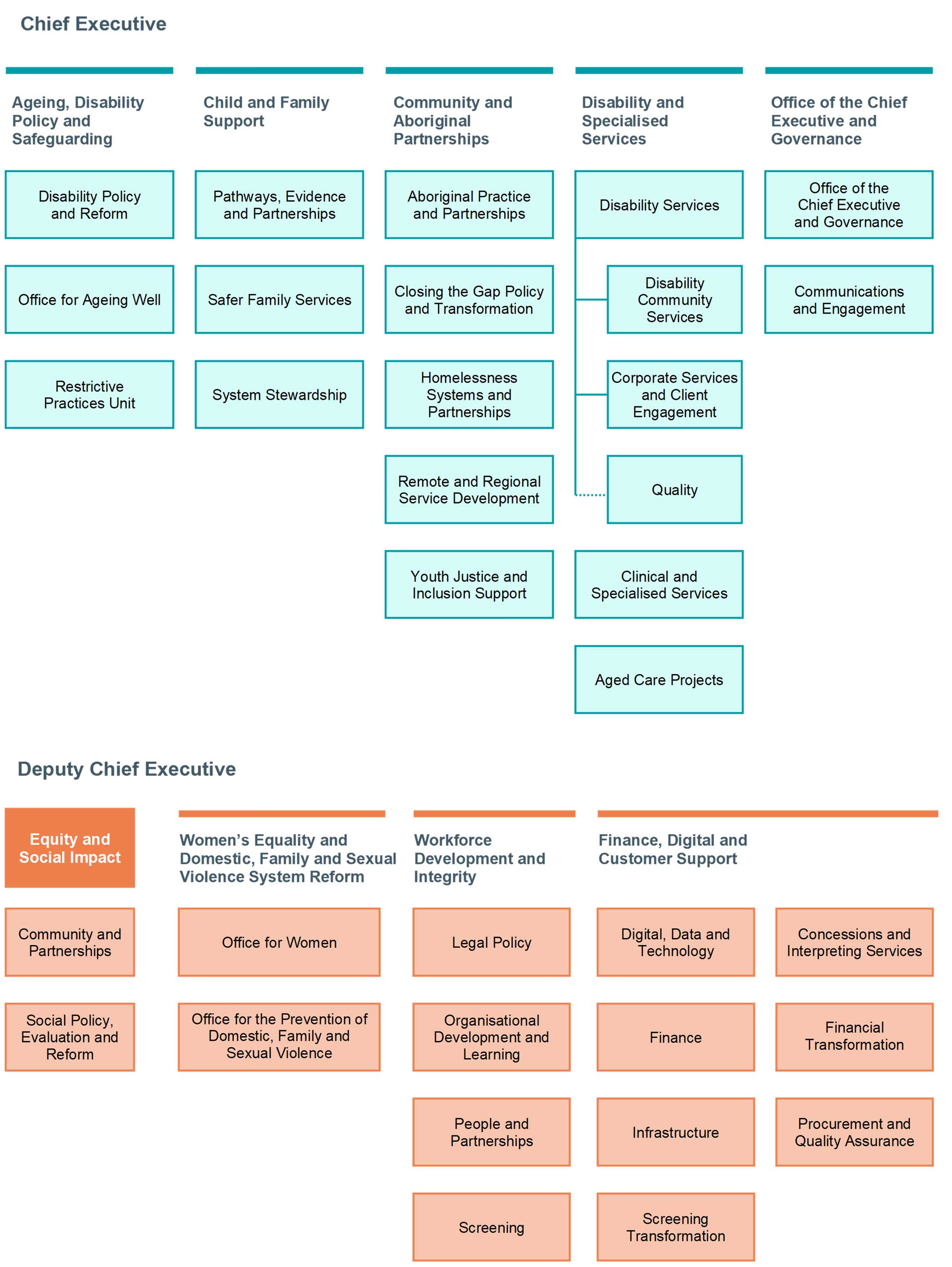
Organisational chart in plain text
This organisational chart reflects the structure of the department as at 30 June 2026. View the current chart.
Changes to the agency
During 2025–26, there were the following changes to the agency’s structure and objectives as a result of internal reviews or machinery of government changes.
- In August 2025, the Women’s Equality and Domestic, Family and Sexual Violence System Reform division was established to strengthen coordination and lead system-wide reform in gender equality and the prevention of domestic, family and sexual violence. The division incorporates the Office for Women and the Office for the Prevention of Domestic, Family and Sexual Violence and is responsible for leading policy and engagement initiatives that improve outcomes for women, as well as coordinating cross-government responses and implementation planning arising from the Royal Commission into Domestic, Family and Sexual Violence.
- In November 2025, the Financial Transformation directorate was established within the Finance, Digital and Customer Support division. The temporary directorate is responsible for overseeing the successful implementation of the Oracle Financial Management System across DHS, providing planning, project management and change management support to the Finance team and the broader department, and partnering with Disability and Specialised Services to achieve its financial sustainability targets.
Our Ministers
Our Ministers as at 30 June 2026:
Hon Katrine Hildyard MP
Minister for Human Services
Minister for Seniors and Ageing Well
Minister for Women
Hon Alice Rolls MP
Minister for Domestic, Family and Sexual Violence
Our Executive team
DHS Executive Leadership Team as at 30 June 2026:
Sandy Pitcher, Chief Executive
Appointed in November 2022, the Chief Executive is responsible for the overall leadership, management and performance of the department, as well as the conduct and capability of its workforce. The Chief Executive is accountable to the department’s Ministers for delivering election commitments assigned to the department and driving the achievement of both whole-of-government priorities and agency-specific outcomes.
Ruth Ambler, Deputy Chief Executive
The Deputy Chief Executive is responsible for the Equity and Social Impact division, which comprises:
- Community and Partnerships, which delivers funding and programs that support community capacity and wellbeing. These include Grants SA, the Financial Wellbeing Program, Affordable SA, the Community Connections Program, Community Transport SA, Carer Breaks and Young Carer Support Services, Gambling Help Services, Youth Support and Development, Services to Aboriginal Youth, Youth Night Buses, the Community and Neighbourhood Development Program, the Advocacy and Impact Program, the Bfriend program for young LGBTIQA+ people, the Whyalla Surviving to Thriving Program, and food security initiatives, including Foodbank SA and Social Supermarkets.
- Social Policy, Evaluation and Reform, which works across DHS, the community sector and government to leverage evidence and learning to support the delivery of the best possible services, programs and outcomes for South Australians, including, but not limited to, young people, carers, volunteers and LGBTIQA+ people.
Joe Young, Executive Director, Ageing, Disability Policy and Safeguarding
The Ageing, Disability Policy and Safeguarding division provides services and support to South Australians in need. The division comprises:
- Disability Policy and Reform, which is responsible for providing strategic leadership across the State Government to advance the state’s disability inclusion and policy agenda. It is also responsible for ensuring that South Australia meets its obligations under the State Disability Inclusion Plan
2025–2029 and the SA Autism Strategy 2024–2029, and for coordinating the state’s involvement in the National Disability Insurance Scheme (NDIS) reform program, the implementation of Australia’s Disability Strategy 2021-2031, and the response to the Royal Commission into Violence, Abuse, Neglect and Exploitation of People with Disability. - Office for Ageing Well, which takes the lead on state ageing policy to safeguard the rights of older South Australians and supports them to live and age well. The office delivers functions under the Ageing and Adult Safeguarding Act 1995, the Retirement Villages Act 2016, South Australia’s Plan for Ageing Well 2026–2036, and a range of related strategic policies, projects, grants and initiatives, including the administration of the Seniors Card program.
- Restrictive Practices Unit, which is responsible for administering the South Australian Restrictive Practices Authorisation Scheme, which provides for the appropriate authorisation, monitoring and reporting of restrictive practices for NDIS participants in NDIS services.
Henry Pharo, Acting Executive Director, Child and Family Support
The Child and Family Support division delivers a range of services, policies and programs that help families remain safely together at home, within their communities and connected to culture. The division comprises:
- Pathways, Evidence and Partnerships, which is responsible for developing a learning system that takes an epidemiological approach to understanding population needs and complexities, and identifying what works best in prevention and early intervention programs to support families. Combined with effective service access pathways and a relational model of contract management, this is strengthening system responsiveness and the evidence base on how to best support families with the right service at the right time.
- Safer Family Services, which provides a range of early intervention, parenting capacity building and intensive family services under the Child and Family Support System (CFSS). Collectively, these programs and services aim to help children remain safe and well within their family, community and culture, reducing the need for out-of-home care.
- System Stewardship, which provides strategic oversight of the CFSS, driving long-term systemic change to better support children and young people. This is achieved through the integration of lived experience into service design, the development of system-wide cultural governance and quality practice guidance, the facilitation of sector communities of practice and co-design processes, and the maintenance of a trauma informed and responsive service system.
Alex Reid, Executive Director, Community and Aboriginal Partnerships
Community and Aboriginal Partnerships delivers support and services to children, young people and families, including individuals involved with the youth justice system and residents of remote Aboriginal communities. The division comprises:
- Aboriginal Practice and Partnerships, which delivers programs and services that aim to divert Aboriginal children and young people from offending behaviour towards positive social outcomes. It also works with key stakeholders to support the delivery of place-based initiatives and culturally led approaches.
- Closing the Gap Policy and Transformation, which provides strategic policy advice and drives the transformational change required to implement the National Agreement on Closing the Gap within DHS, with the aim of improving outcomes for Aboriginal peoples, their families and communities.
- Homelessness Systems and Partnerships, which is responsible for the strategic oversight and commissioning of specialist homelessness services that support individuals and families experiencing, or at risk of experiencing, homelessness. It is also responsible for the management of homelessness information and data systems and the extreme weather response.
- Remote and Regional Service Development, which works collaboratively with services and communities to plan, develop and implement community responses that improve outcomes for Aboriginal people and communities in South Australia. These responses include assertive outreach in public areas and tenancies, Return to Country, connecting people with other services, and service collaboration.
- Youth Justice and Inclusion Support, which is responsible for the statutory supervision of young people in contact with the justice system, including the management of the Kurlana Tapa Youth Justice Centre and community-based supervision and support. The directorate is also responsible for the Inclusion Support Program, which oversees South Australia’s countering violent extremism interventions and community awareness, and the African Community Response pilot program, which supports young people from African communities who are in contact, or at risk of contact, with the justice system.
Kirsty Delguste, Executive Director, Disability and Specialised Services
Disability and Specialised Services delivers essential support to South Australians through high-quality NDIS services, aged care services and service responses for individuals with high and complex needs whose needs are not met through mainstream services. The division comprises:
- Disability Services, which includes:
- Disability Community Services, which provides home and living supports to people with disability at home and in the community through a range of disability and other funding packages, including the NDIS.
- Corporate Services and Client Engagement, which provides strategic and technical support to Disability Services, including client intake, rostering, billing and claims management, and service agreement administration.
- Quality, which is responsible for ensuring compliance with the NDIS Practice Standards, policies and procedures, monitoring service delivery, incident management, external reporting, feedback and complaints, supporting continuous improvement, conducting audits, and promoting client safety and rights.
- Clinical and Specialised Services, which includes:
- Clinical Services, which provides specialised coordination, allied health, nursing and positive behaviour support to assist clients in navigating the NDIS and build independence.
- The Equipment Program, which enables access to assistive technology, home modifications and specialist equipment that improve independence, function, mobility and community living outcomes for eligible South Australians.
- The Exceptional Needs Unit, a statewide service that works with individuals and families who present with significant complexity and vulnerability, and for whom mainstream service options have been exhausted, are ineffective, or are unavailable.
- Transition to Home Program, which offers short-term accommodation and support for NDIS participants transitioning from hospital to their permanent home, ensuring continuity of care.
- Aged Care Projects, which manages Disability SA Northgate, a Commonwealth-funded aged care service established as a high-care residential facility specialising in supporting clients with intellectual disability.
Nick Ashley, Chief Financial Officer, Finance, Digital and Customer Support
The Finance, Digital and Customer Support division is responsible for delivering a range of finance, digital, technology and customer support services and comprises:
- Concessions and Interpreting Services, which delivers a range of concessions and rebates that assist South Australian households on low or fixed incomes with cost-of-living pressures. It is also responsible for the operation of the Interpreting and Translating Centre, which includes the Aboriginal Language Interpreting Service.
- Digital, Data and Technology, which is responsible for the provision of information management, systems, data and technology services to support the department and the services it delivers.
- Finance, which is responsible for providing strategic financial advice, budgeting, management accounting, financial monitoring and reporting, the execution of a range of financial authorisations, and ensuring compliance with departmental and Treasury policies and frameworks.
- Financial Transformation, which is responsible for managing the implementation of the new whole-of-government financial system in DHS and supporting the Disability Financial Sustainability Strategy.
- Infrastructure, which provides a range of asset-related services, including asset and building management, security services, records management, fleet and transport management, and mail services.
- Procurement and Quality Assurance, which supports all areas of the department in procuring goods and services and is responsible for the delivery of the Australian Service Excellence Standards to support organisations to improve their business practices and client services.
- Screening Transformation, which leads a major program of work to reform the Screening Unit’s processes and systems and improve the delivery of screening checks for workers and volunteers across South Australia.
Kerry Beck, Executive Director, Women’s Equality and Domestic, Family and Sexual Violence System Reform
Women’s Equality and Domestic, Family and Sexual Violence System Reform comprises:
- Office for Women, which works across government and the community to improve women’s participation in leadership and decision-making, and to advance women’s economic empowerment. The office has a strong focus on addressing domestic, family and sexual violence and provides statewide information and referral services through the Women’s Information Service, as well as executive support to the Premier’s Council for Women.
- Office for the Prevention of Domestic, Family and Sexual Violence, which is responsible for providing the Royal Commission into Domestic, Family and Sexual Violence with a coordinated, whole-of-government response from the South Australian Government.
Sally Nicholas, Executive Director, Workforce Development and Integrity
The Workforce Development and Integrity division comprises:
- Legal Policy, which leads the response to complex legal and misconduct matters with integrity and transparency, oversees strategic policy development, and ensures legal frameworks remain current and aligned with government priorities. It also drives organisational improvement through performance monitoring, capacity-building initiatives, and fostering a culture of ethical governance and continuous improvement.
- Organisational Development and Learning, which provides expertise and services in individual and organisational learning, development and recruitment to build leadership capability and support workforce strategies and initiatives.
- People and Partnerships, which partners with departmental leaders to provide efficient, solution-focused and innovative people services that support the delivery of responsive and effective services to improve the wellbeing and safety of South Australians.
- Screening, which conducts screening, ongoing monitoring and background checks of specific workers and volunteers in South Australia, contributing to safe environments for children and other vulnerable people in the community.
Belinda Marsden, Director, Office of the Chief Executive and Governance
The Office of the Chief Executive and Governance is responsible for a range of functions, including correspondence and briefings, Cabinet coordination and Parliamentary business, corporate governance, the department’s internal audit function, risk management and business continuity. It also provides high quality and responsive advice and support to the Ministers’ Offices, the Chief Executive and the Deputy Chief Executive.
The Director is also responsible for:
- Communications and Engagement, which provides advice and services across a range of areas, including media management, internal and external communications, promotions, events, social media, and graphic and multimedia design.
- Administrative reporting responsibility for staff in the Office of the Minister for Human Services, Minister for Seniors and Ageing Well, Minister for Women and the Community Visitor Scheme.
Legislation administered by the agency
As at 30 June 2026, the department had administrative responsibility for the following Acts committed to its portfolio Ministers:
Minister for Human Services
Ageing and Adult Safeguarding Act 1995
Carers Recognition Act 2005
Child Safety (Prohibited Persons) Act 2016
Children’s Protection Law Reform (Transitional Arrangements and Related Amendments) Act 2017
Cost of Living Concessions Act 1986
Disability Inclusion Act 2018
Disability Services Act 1993
Julia Farr Services (Trusts) Act 2007
Not-for-Profit Sector Freedom to Advocate Act 2013
Supported Residential Facilities Act 1992
Volunteers Protection Act 2001
Youth Justice Administration Act 2016
Minister for Seniors and Ageing Well
Aged Citizens Clubs (Subsidies) Act 1963
Retirement Villages Act 2016