
Connection to culture, Country and community is helping Aboriginal men build confidence, friendships and a strong sense of belonging.
Through the DHS Community Connections Program, Moorundi Aboriginal Community Controlled Health Service delivers a Men’s Group in Murray Bridge and Victor Harbor, creating a safe and supportive space for men to connect and support one another.
Moorundi’s Chris Hawkins shares the story of the group, the experiences bringing the men together and why the program means so much to him.
Read Chris's story
Our Community Connections Program through Moorundi, operating across Murray Bridge and Victor Harbor, has built something truly special within our Men's Group. From the very beginning, our focus has been on strengthening connections to culture, country, and community while supporting vulnerable Aboriginal men socially, emotionally, and culturally.
We have worked hard to create a safe and supportive space where men feel respected, valued, and connected. What started as a men's group has grown into much more than that—it has become a brotherhood. It has become a family where the fullas support one another, lift each other up through difficult times, celebrate each other's successes, and walk alongside each other on life's journey.
One of the most rewarding parts of this journey has been witnessing the positive changes in the lives of the men. We have supported several men to enter rehabilitation programs, and this week we celebrate one of our clients graduating from rehab. Having faced my own battles with drugs and alcohol in the past, I understand just how significant these milestones are. Seeing these men take those steps towards healing is something I am incredibly proud to be part of.
Since establishing the group, we have run four cultural camps, including a three-day camp to Wallaroo, a four-day camp to Victor Harbor, and two five-day camps to Mount Gambier. Throughout these camps, the men have taken part in a wide range of activities including cooking, fishing, golfing, basketball, football, bushwalking, cultural tours, charter fishing trips, and much more.
The camps are about far more than activities. They create opportunities for the men to reconnect with culture, develop confidence, strengthen friendships, and experience things many of them never imagined possible. The fullas work together to prepare meals, often holding friendly cook-offs where they cook for the entire group. Watching everyone pitch in and take pride in contributing really highlights the importance of the program and the sense of belonging it creates.
One of the highlights has been our charter fishing trips from Port MacDonnell in South Australia's south-east. I still remember the first trip. On the drive down, the fullas kept asking me, "How far out are we going?" "Will we still be able to see land?" "How deep is it going to be?" All I could do was laugh because I'd never been on a charter boat myself.
As we travelled further offshore and the coastline slowly disappeared from view, one of the men looked at me and said, "What in the hell did you bring us all the way out here for?" I smiled and replied, "To put you outside your comfort zone and give you the opportunity to do something you might never get the chance to do."
He stood up, gave me a big hug, and said, "I love you, my brother."
Moments like that remind me exactly why we do what we do. It's about creating experiences that build confidence, trust, and lifelong memories.
Another unexpected success has been golf. What started as a spontaneous activity quickly became one of the group's favourites. We hire a few golf carts, have plenty of laughs, enjoy each other's company, and spend quality time outdoors on Country. The men loved it so much that we've made golf a regular part of our program and now aim to play a course wherever we hold our camps. It's a fantastic way to reduce stress, enjoy the outdoors, and support both mental wellbeing and social connection.
We've also introduced traditional wood carving sessions where the men create their own didgeridoos, clapsticks, walking sticks, and other cultural items. These activities allow the fullas to reconnect with Country and culture in a meaningful way. Seeing grown men become excited like kids while learning from Elders, exploring cultural sites, or creating something with their own hands reminds us just how important these cultural connections are.
Our support extends well beyond group activities. We work alongside the men to help remove barriers that impact their lives, whether that's assistance with housing, Centrelink, court matters, referrals to other community services, or simply being someone, they can rely on when things become difficult. Our role is to walk beside them, wherever they are in their journey.
Looking ahead, we're excited to continue growing the program. One initiative we're developing is a Father and Son Group, where men can bring their sons, nephews, grandsons, or other young family members to participate in cultural activities together. The aim is to strengthen family relationships, create opportunities for young fullas to spend time with Elders, and continue passing on knowledge about Country, culture, and identity to the next generation.
This is only the beginning, and we're looking forward to sharing more about these future programs as they develop.
I genuinely love what I do because I know the difference these programs can make. Community means everything to me. I don't want to be seen as just another support worker—I want to be someone who is part of the community, someone who walks alongside them, understands their struggles, and celebrates their successes.
I want the men to know that I'm no different to them. I've had my own challenges, and in many ways I need this program just as much as they do. Without my community, I wouldn't be able to do the work that I love. They inspire me every day, and they remain at the heart of every decision I make and everything I do in my role.
Together, we're not just building a men's group—we're building stronger men, stronger families, and stronger communities through culture, connection, and Country.
Men's Group at Victor Harbor Golf Course
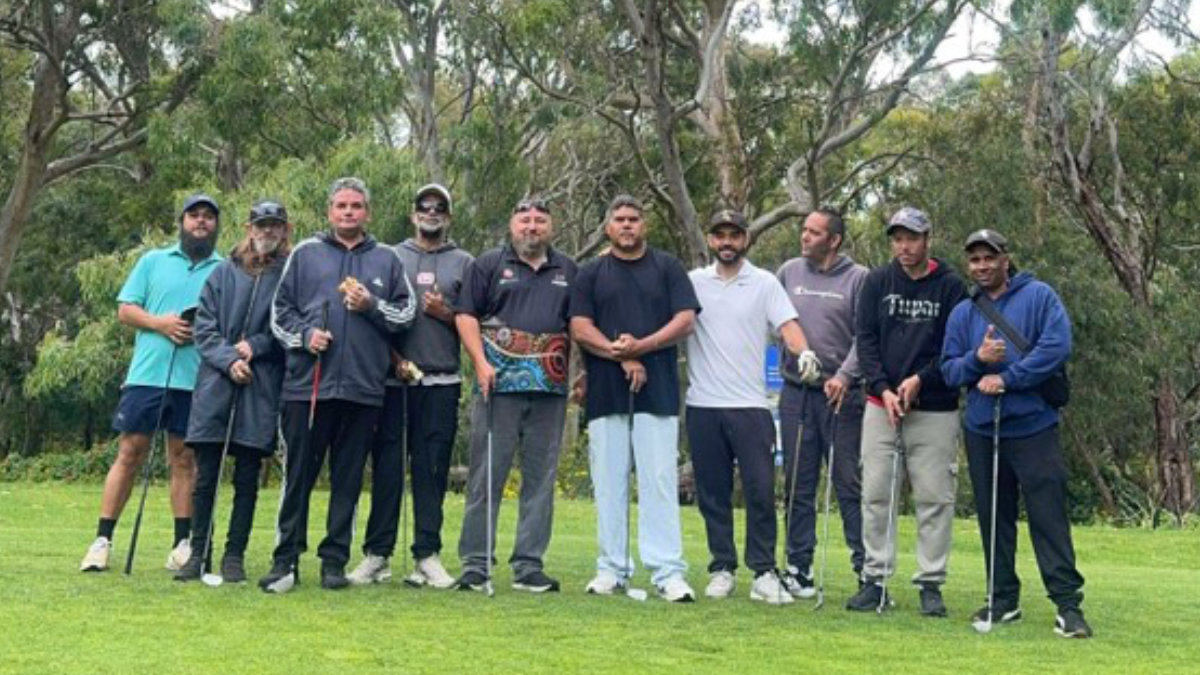
Group members
Left to right: Khian Rigney-Smith, Paul Birchall, Jason Burns, Jason Lovegrove, Chris Hawkins, Lalo Kartinyeri, Everette Giles, Lawson Rigney, Eddie Smith, Jeffrey Johnson