
Download print version:
On this page:
Acknowledgement of Country
We acknowledge and respect Aboriginal people as the state’s First Peoples and Nations and recognise Aboriginal people as the Traditional Owners and occupants of Land and Waters in South Australia.
We acknowledge that the spiritual, social, cultural, and economic practices of Aboriginal people come from their traditional lands and waters, and that the cultural and heritage beliefs, languages and laws are still of importance today. We are committed to ensuring that the needs and aspirations of Aboriginal people are incorporated in the design, development, monitoring and evaluation of efforts across the Child and Family Support System.
Artist acknowledgement
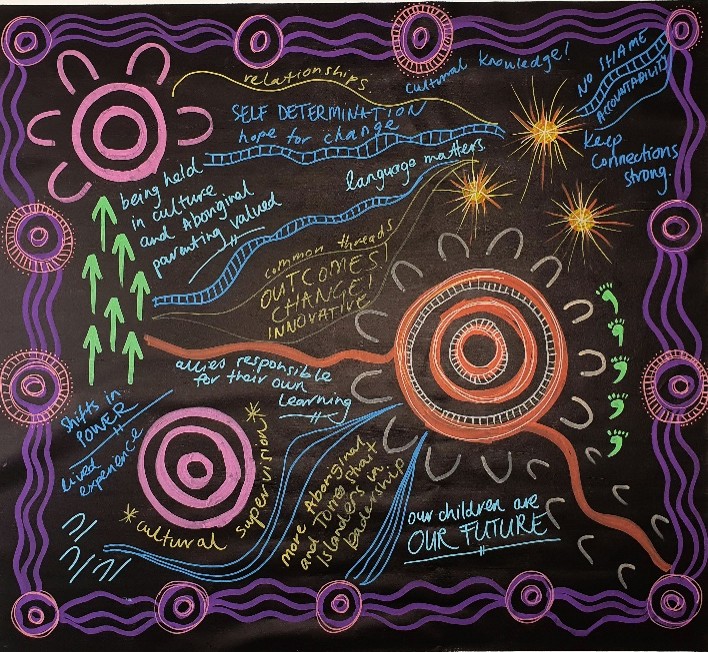
The Aboriginal Cultural Lenses of Practice artwork was created in 2020 as a visual statement piece by Sasha Houthuysen/Hill, a Yamatji/Noongar woman, in partnership with the Department of Human Services (DHS) Safer Family Services Aboriginal staff and allies.
It gives a voice to Aboriginal ways of knowing, being, doing and guidance in supporting a culturally safe workforce.
The artwork is used throughout the department’s Child and Family Support System (CFSS) policy and practice resources. It incorporates the symbols representing the cultural lenses journey: allies walking alongside Aboriginal staff, families and communities, and meeting and learning places supporting Aboriginal best practice.
This ensures that we are always keeping children front and centre and working from a culturally safe lens.
Introduction
This document provides an overview of the Aboriginal Connections Team (ACT) and the context of where it sits within the Child and Family Support System (CFSS). It articulates the scope of the service, key values and principles, objectives, and outcomes. The service delivery practices, outputs and service elements are described, and the service flow is represented.
The service recognises the overrepresentation of Aboriginal children and families involved in the child protection system, and the unmet need of families being supporting through intensive and early intervention services.
History of CFSS and ACT
This document should be read in conjunction with Department of Human Services (DHS) Child and Family Support (CFS) Division strategic documents and Safer Family Services policy and practices guides, including the Safer Family Services Aboriginal Cultural Practice Framework.
During 2018–2019 the SA Government undertook an extensive process of research and co-design aimed at drawing on evidence-informed knowledge and practice to better support early intervention and improve child safety and wellbeing. This was combined with lived and professional experience, to design the CFSS to ensure that South Australia delivers the best possible outcomes for children and their families. The remit of the CFSS is to work with families to support them to keep their children safe and well at home in family, community, and culture. CFSS has a focus on the following four priority population groups:
- Young parents (where mothers are aged under 23 years and fathers aged under 25 years)
- Families of infants deemed to be at high risk in their first 1 thousand days
- Aboriginal families with multiple and complex needs
- Young people experiencing vulnerability and at risk of having children who may go on to enter the child protection system
DHS and the Child & Family Support Division have oversight of the CFSS. Intensive Family Services (IFS) are a core component of the CFSS service infrastructure. IFS are specialist services for families with high level safety concerns. IFS practitioners provide intensive case management to help disrupt the patterns of intergenerational trauma and increase the number of children able to be safely cared for in their homes, and to remain connected to culture and community. IFS practitioners work with the family and other key partners to address risks, but also develop goals and strategies to strengthen family safety, wellbeing and functioning. IFS are provided by both government Safer Family Services (SFS) and contracted Non-Government Organisations (NGOs) and Aboriginal Community Controlled Organisations (ACCOs).
ACT was implemented as a partnership approach to assist ACCO IFS providers with initial engagement with complex families being referred to ACCO service providers. ACCOs were also seeking partnership with DHS to ensure robust levels of information sharing regarding child safety concerns.
ACT commenced service delivery in 2023, supporting ACCOs through culturally focused referral preparation to IFS, information sharing, initial home visit support to share child safety concerns, and facilitating reconnection with families if ACCO IFS have been unable to maintain engagement. ACT has worked with other business units within the CFSS to support the engagement of vulnerable Aboriginal families with support services, including support to CFSS Pathways Service and Child and Family Safety Networks (CFSNs).
An Aboriginal workforce forum conducted in August 2023 was an opportunity to strengthen community support systems and empower the workforce by elevating their knowledge and understanding of the Child & Family Support System and the Aboriginal Connections Team. The forum sought to gather insights relating to the rights of Aboriginal children, parents and caregivers, engagement with families and training and development opportunities. The outcomes and aspirations from this session have informed the development of the ACT Service Model.
The development of ACT as a culturally responsive diversionary service for families that are eligible for IFS but unable to be provided this service due to capacity constraints has been refined through 2023-24 and is further outlined within this service model.
Vision
The CFSS vision is that all children are safe and well at home, in family, community, and culture. This overarching vision guides the work of ACT, who work to strengthen the wellbeing of Aboriginal children and divert them and their families from escalated contact with the child protection system by connecting families to appropriate supports. Families are empowered through Family Led Decision Making, the recognition and elevation of their cultural strengths, and strengthened community connections.
Guiding Principles
ACT is one of a number of services and programs within the CFSS that plays a critical role in supporting families to keep children safe and well at home, reducing the need for children to be removed from their families to ensure their safety.
Engagement and the work undertaken with families is supported and guided by the following principles:
Aboriginal Family-Led Decision Making
Aboriginal Family-Led Decision Making (AFLDM) is a process that allows for meaningful involvement of the family (and their important networks and supports) in the case work process. The process supports the right to self-determination of Aboriginal and Torres Strait Islander families to make decisions about how to keep their child or young person safe and connected to family, culture and community. AFLDM is both an identified standalone model as well as a best practice model that recognises the significant roles that all family members can play in the life of children and young people.
Safer Family Services, Aboriginal Cultural Practice Framework
The Voice of the Child
In ensuring that the best interests of the child are central to decision-making, the voice of the child or young person is heard and elevated. Children’s views on child safety and their wellbeing are actively sought and used to inform conversations with parents and caregivers regarding their child’s needs, and to support Aboriginal Family-Led Decision Making (AFLDM).
Children are supported as active participants in their own right within their family. ACT practically supports the elevation of young voices and connection to community and services to ensure that their needs are met. Child safety supersedes all other rights within the CFSS non-statutory service provision. Effort to engage with children and young people, is as important as engaging with their adult carers or parents. Their views and wishes for safety and wellbeing must be heard within the context of their families and communities.
Self-Determination
As reflected in Articles 2 & 3 of the United Nations Declaration on the Rights of Indigenous Peoples, ACT work under the principle that Indigenous peoples have the right to self-determination. By virtue of that right they freely determine their political status and freely pursue their economic, social and cultural development and Indigenous peoples, in exercising their right to self-determination, have the right to autonomy or self-government in matters relating to their internal and local affairs, as well as ways and means for financing their autonomous functions.
Aboriginal and Torres Strait Islander Child Placement Principle (ATSICPP)
As developed by SNAICC and legislated throughout South Australia through the Children and Young People (Safety and Support) Bill, ACT recognises and supports children being connected to their families, communities, cultures and country through the Aboriginal and Torres Strait Islander Child Placement Principle (ATSICPP).
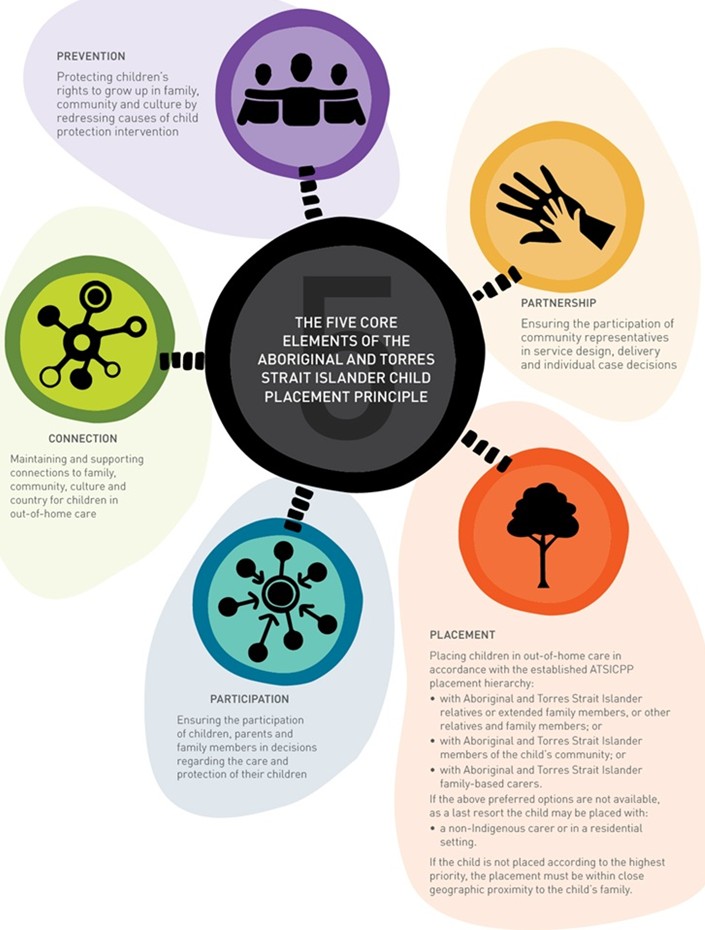
Diagram Source: SNAICC – National Voice for Our Children The Aboriginal and Torres Strait Islander Child Placement Principle: A Guide to Support Implementation 181212_8_ATSICPP-Guide-to-Support-Implementation-1.pdf
The full text from the image is available at Appendix 1.
The Aboriginal Connections Team practice approach is aligned with and guided by the five core elements of the Aboriginal and Torres Strait Islander Child Placement Principle. This approach is further embedded through integration with the ACT ATSICPP Implementation Plan.
Element 1 – Prevention
Aboriginal Connections Team align practice with Element 1 – Prevention, by centring family-led decision making as a core strategy to empower families and uphold cultural authority. They work in partnership with families and communities to identify strengths, needs, and culturally appropriate solutions before statutory intervention becomes necessary. Through culturally safe engagement, they facilitate decision-making processes that are led by families, supported by Elders and community members, and informed by Aboriginal ways of knowing and being. This approach not only strengthens family capacity but also reinforces the child’s right to grow up connected to kin, culture, and Country. By embedding prevention in practice, the ACT Practitioners actively reduce the risk of child removal and promote long-term wellbeing for Aboriginal children and their families.
Element 2 – Partnership
Rooted in the principle of collective responsibility, a team of Aboriginal frontline practitioners embraces Element 2 – Partnership, by actively co-designing child safety responses with families, communities, and Aboriginal community-controlled organisations. Relationships are built on trust, respect, and reciprocity, ensuring that Aboriginal voices lead the way in planning and decision-making. Through family-led decision making, culturally safe spaces are created where families are empowered to shape outcomes for their children. This collaborative approach strengthens resilience and ensures that services reflect the values, strengths, and aspirations of Aboriginal people, ultimately safeguarding children’s rights to grow up strong in culture and community.
Element 3 – Placement
Guided by the deep cultural understanding that children thrive in kinship and community, the ACT practitioners align their practice with Element 3 – Placement, by prioritising family scoping and genogram development when a statutory response is required, even though the team do not have a role in child placement. These tools are used to map out extended family and cultural connections, ensuring that any decisions made by statutory bodies are informed by a comprehensive understanding of the child’s kinship network. Through family-led decision making, the team supports families to identify safe and culturally appropriate carers, guided by the wisdom of Elders and community knowledge. This approach strengthens the likelihood of placements that honour the child’s identity, cultural continuity, and connection to Country, even in times of disruption.
Element 4 – Participation
Grounded in the belief that Aboriginal families and communities are best placed to make decisions about their children, the Aboriginal Connections Team practice is aligned with Element 4 – Participation, by ensuring that Aboriginal voices are central in all child safety processes. While the team does not hold statutory decision-making authority, they play a critical role in facilitating family-led decision making, creating culturally safe spaces where families can express their views, share their stories, and lead planning for their children’s wellbeing. They also work to connect families with culturally appropriate services, ensuring that supports are accessible, responsive, and aligned with the family’s goals and cultural values. By advocating for inclusive engagement and holistic service coordination, the team strengthens the child’s right to be heard and promotes outcomes that reflect identity, connection, and community-led solutions.
Element 5 –Connection
With a strong commitment to preserving cultural identity and belonging Element 5 – Connection, is aligned with practice by supporting children and families to maintain and strengthen ties to kin, culture, and Country. Cultural connection is a priority throughout the service response. Through family-led decision making, families identify key relationships and cultural supports, using tools like genograms and family scoping to map connections and inform planning. Practitioners work to link families with culturally safe services that reinforce cultural knowledge, language, and traditions. This approach ensures that children continue to grow up with a strong sense of identity, pride, and connection to their culture and community.
Active Efforts in Practice
The Aboriginal and Torres Strait Islander Child Placement Principal - A guide to support implementation provides guidance on embedding active efforts across all five elements of the ATSICC. Additionally, it provides examples of practice in applying active efforts within a range of services and systems including family support.
The Principle was developed by SNAICC — Secretariat of National Aboriginal and Islander Child Care — the National Peak Body for Aboriginal and Torres Strait Islander Children.
Active efforts require practitioners to help families overcome barriers to their participation in services which enable families to stay together or be reunified. Embedding active efforts ensures compliance with all five elements of the Aboriginal and Torres Strait Islander Child Placement Principle.
The diagram below provides practical examples that support active efforts in implementing the ATSICPP. These examples are recognised by ACT and align with their practice approach when working with Aboriginal families and communities.
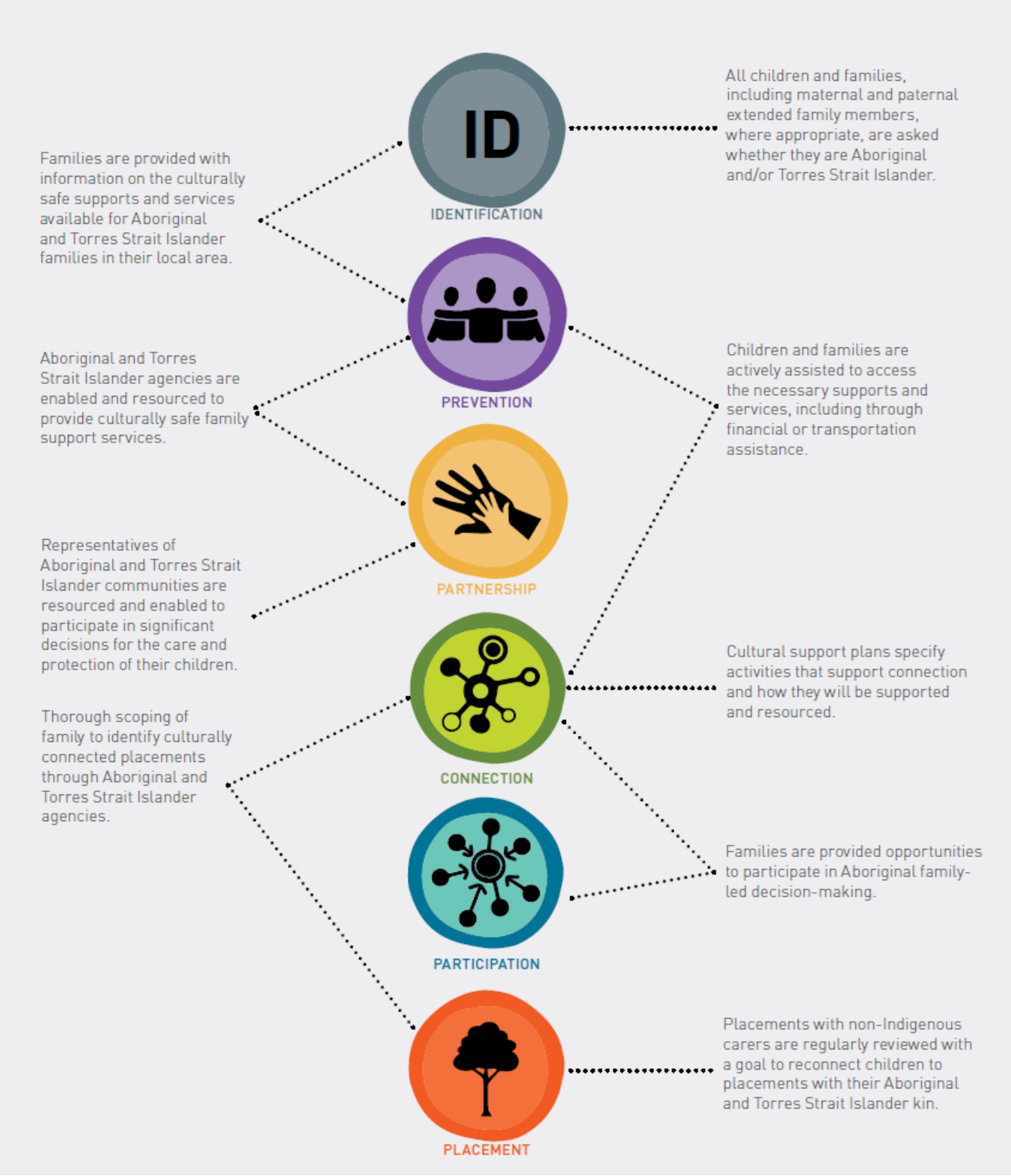
Diagram Source: SNAICC – National Voice for Our Children The Aboriginal and Torres Strait Islander Child Placement Principle: A Guide to Support Implementation.
The full text from the image is available at Appendix 2.
Partnership
As defined by Clause 32 of the National Agreement, ACT supports working in strong partnership with key stakeholders and community, which includes transparency and accountability within defined roles, and promotes shared decision making.
ACT works in collaboration with families and service providers, committed to the goal of keeping Aboriginal children safe within their homes, families and communities. The following principles underpin these partnerships and support their success:
Underpinning Partnership Principles
Child-Centred Approach
Focus on the well-being and cultural identity of the child in all decisions.
Cultural Responsiveness
Integrate culturally responsive practices and honour cultural wisdom and traditions.
Honesty
Maintain clear, truthful communication about child safety concerns, parental responsibilities, processes, decisions, and expectations.
Strength Recognition
Identify and build upon the inherent strengths and resilience within the family and community.
Mutual Respect
Honour and value the family's culture, traditions and knowledge.
Shared Journey
Walk alongside the family as partners in a collective process.
Community Connection
Foster and support the family's connections to their community and cultural heritage.
Empowerment through Knowledge
Support the family in understanding their rights, options and the service system, fostering self-determination within the context of child safety.
Collective Accountability
Ensure that services are responsible to the community and uphold commitments to the family.
Flexibility and Adaptability
Tailor services to meet the unique and growing needs of the family.
Addressing the multifaceted issues faced by Aboriginal children, young people, and their families requires a collaborative approach beyond the capacity of a single agency.
To support families, ACT works in partnership with communities and a broad range of stakeholders to provide culturally responsive and integrated responses that promote the wellbeing and safety of children and families.
To support strong cultural partnerships, ACT actively engages with key Aboriginal community networks to build meaningful relationships and collaborations, fostering mutual trust and genuine collaboration.
The partnership with the Early Intervention Research and Data team (EIRD) allows for the collection of data and evidence that informs the broader system landscape as well as proven best practice program development. The development of current and accurate data sets allows for evidence-informed truth-telling conversations and identification of effective practice and meaningful outcomes.
ACT proactively engages with key partners —
Internal to the DHS Child & Family Support Division:
- CFSS Pathways Service
- Child and Family Safety Networks (CFSNs) including external network partners
- Early Intervention Research and Data team (EIRD)
- Safer Family Services (SFS)
- Multi Agency Protection Service (MAPS)
- Performance and Partnerships
External to the DHS Child & Family Support Division:
- Aboriginal Community Controlled Organisation (ACCO)
- Aboriginal Community Controlled Health Organisations (ACCHOs)
- Aboriginal community networks
- Department for Child Protection (DCP)
- Department for Education (DfE)
- Metropolitan Aboriginal Youth and Family Services (MAYFS)
- Non-Government Organisations (NGO)
- Non-Government Organisation (NGO) IFS
- SA Health
- South Australian Housing Trust (SAHT)
- SA Police (SAPOL).
Truth-telling
The National Agreement encourages government organisations to facilitate truth telling to enable reconciliation and active, ongoing healing while The Uluru Statement from the Heart asks for ‘a fair and truthful relationship with the people of Australia based on justice and self-determination.’
Truth telling creates safe spaces for families to share their experiences and determine what works best for them. Through supporting genuine and open conversations with families, ACT practitioners play an important role in understanding the history and contributing factors of each family, as well as providing transparent information about the child protection system.
Restorative Practice
Restorative practice focusses on building and maintaining positive and healthy relationships, resolving difficulties, and repairing harm when relationships break down. It creates a common language and approach for fostering a sense of social responsibility and shared accountability. Families are encouraged to be involved in considering risk and concerns and be active participants in solution focused planning to solve problems, build relationships and repair harm. Restorative practice also creates opportunities for those who have experienced harmful and unhealthy relationships to heal through experiencing positive and collaborative relationships.
Strengths-based approach
This approach to working with children, young people and families acknowledges and identifies the inherent strengths, abilities and past achievements of individuals and family groups. It is a solution focussed process that views the safety of the child as paramount and draws on the strengths and abilities of the family to develop or utilise past strategies to achieve safety, positive change and enhance self-determination. The safety of children is considered in the context of the presenting risks and the extent to which strengths can influence safety and mitigate risk.
Assertive Engagement
Assertive engagement takes a proactive approach to delivering support. It challenges the idea that a client is always responsible for engaging with services and instead places the responsibility for the success or failure of engagement with the practitioner and their agency. It requires practitioners to persistently and consistently approach the client to build a relationship, to engage them in critical conversations about risk, capacity and functioning, and to continue to offer support.
Guiding National Policy
Closing the Gap
Like all government parties, DHS is signatory to the National Agreement on Closing the Gap (the National Agreement), and as such, is committed to being accountable and culturally safe and responsive to the needs of Aboriginal peoples. The National Agreement specifies four overarching Priority Reform areas as well as 17 socio-economic targets and outcomes. Outcomes 12, Aboriginal and Torres Strait Islander young people are not over-represented in the child protection system and Outcome 13, Aboriginal and Torres Strait Islander families and households are safe directly speak to the work undertaken within ACT. DHS also holds responsibility for the implementation and development of specific actions within South Australia’s Implementation Plan 2024-2026.
United Nations Convention on the Rights of the Child (1989)
- All children have the right to grow up in an environment free from neglect and abuse. Their best interests are paramount in all decisions affecting them.
- Improving the safety and wellbeing of the children is a national priority.
- The safety and wellbeing of children is primarily the responsibility of their families, who should be supported by their communities and governments.
- Australian society values, supports and works in partnership with parents, families, and others in fulfilling their caring responsibilities for children.
- Children and their families have the right to participate in decisions affecting them.
- Policies and interventions are evidence informed.
- Children’s rights are upheld by systems and institutions.
Guiding Legislation
Children and Young People (Safety and Support) Bill
As defined by Section 11 of the Children and Young People (Safety and Support) Bill, “the best interests of each child and young person are to be upheld and effected in all decision making.”
Children and Young People (Safety and Support) Bill 2024
In supporting the best interest of the child, engagement with families centres and prioritises the needs of the child. In some circumstances, this may require services to proactively seek to engage with children and families to discuss and understand the referred child safety concerns and seek the views of the family on their strengths and needs, and to better understand the family’s circumstances.
Service Scope
ACT is a vital part of the CFSS, specialising in tailored connection services for Aboriginal families. ACT works directly with Aboriginal families to deliver support across the following service domains:
- Working directly with infants, children, young people and families through the provision of short-term diversionary services
- Working directly with systems to develop and support community connections, service accessibility and access to resources for vulnerable children and their families
Referrals to ACT are initially received by the CFSS Pathways Service through pre-approved referral pathways and then triaged by CFSS Pathways Service for an ACT service. Aboriginal families are suitable for triage to ACT from the CFSS Pathways Service, in consideration of any of the following:
- Adolescents at risk who have limited-service support options
- Households with multiple family units and complexities across family units
- Families where services have failed to engage or maintain engagement with the family
- Families who have been re-referred for a CFSS response multiple times
- Transient families or families with an unknown location
- Referrals that require further information gathering or clarification of the child safety concerns or family circumstances
- Young parents that are care leavers, who possess a reluctance to engage with services due to their lived experience and trauma
- Negotiated referrals where ACT is sought as able to provide a culturally responsive service that will best meet the needs of the family
- Education referrals where Aboriginal Education staff are seeking support and collaboration
Staff use their cultural wisdom to establish initial engagement and build rapport with families in order to foster open discussions about parenting and child safety. Through assertive engagement methods and accepting responsibility for engagement success, (including undertaking home visits and seeking face to face contact), ACT builds trusting relationships with families that prioritise child safety and empowerment of families to meet their children’s needs for safety.
By participating in truth telling conversations and identifying cultural strengths, ACT conduct a thorough risk assessment, supported by personalised connection plans that address identified child safety concerns and family needs to achieve long-term goals of wellbeing, healthy family functioning and connection to culture. The active involvement of children and young people ensures that their voices are heard in family led decision-making processes. Ultimately, ACT empowers Aboriginal families to improve the social, health, and wellbeing outcomes for their children, and divert them from the statutory child protection system.
Culturally responsive engagement practices and the development of family led connection plans to support child safety and wellbeing allows ACT to divert Aboriginal families from further escalation into the child protection system. Due to limited capacity for service provision within the CFSS, often referrals are unable to be allocated to a service provider. In these cases, Aboriginal families across Metropolitan Adelaide are referred to ACT for a diversionary service. Families residing in the Western and Northern suburbs are often prioritised due to the larger population size and ability for referrals to be accepted by service providers.
Where active child safety concerns are unable to be mitigated through a connection plan, ACT may advocate for the family to be referred for an episode of IFS support. IFS support is provided by ACCO, NGO or SFS IFS providers. An IFS referral will be discussed with the family prior to being made, with every effort made to support family led decision making in relation to family preferences about preferred providers. ACT is then able to support the family with a warm hand over to the IFS provider.
ACT has a responsibility for ensuring the safety and wellbeing of children and young people, and as such, in circumstances where the risk is considered too high for an IFS service to mitigate (at the point of initial referral to CFSS Pathways Service), the CFSS Pathways Service will contact DCP to discuss the suitability of the referral. A service response may be negotiated between the two agencies e.g. IFS allocation, joint IFS/DCP work (including warm referral joint home visits), notification to SAPOL and/or DCP allocation. During this process, ACT advocate for culturally responsive services.
ACT also continues to work alongside ACCOs when requested. ACT are available to support ACCO providers with initial engagement with vulnerable families referred to them directly by CFSS Pathways Service, through joint home visits and truth telling conversation with families regarding child safety concerns. If engagement cannot be sustained or has ruptured, ACT are also able to support ACCO’s to reconnect with families by liaising with the family and providers to reconnect and broker service support. ACT can support with assessment of child safety and consideration of escalation to DCP if providers feel they are unable to mitigate child safety concerns.
Practice Approach
As a diversionary service, the support offered by ACT to Aboriginal children and their families is a short-term period of support, typically lasting between three to four weeks. This intensive case work is strongly focused on assertive engagement, creating shared understanding of the needs of the child and family, and linking the family to community and professional supports to meet these needs and increase child safety and wellbeing. ACT do not provide ongoing intensive case management to Aboriginal families; this support is sought from IFS providers if child safety concerns cannot be improved through ACT case work and the development of a connections plan.
ACT engages in transparent and truth telling conversations, discussing child safety concerns with families whilst seeking to understand each family’s circumstances and strengths. In many instances, ACT’s engagement with the family is the first conversation that families are invited to participate in regarding child safety concerns held within community. To support family led decision making and empowerment, ACT seeks to share information with parents about the child protection system and how best to navigate this system, to ensure that child safety concerns are addressed.
ACT uses a cultural lens to conduct thorough assessments and work with families to prepare detailed family connection plans to enable timely supports within community. Families are empowered through family-led decision making and recognition of their cultural identity, providing tailored connection to services and advocacy for child rights within their family and community. Collaborating closely with communities and service providers, ACT aims for children to remain safely within their homes, families and communities.
ACT service delivery incorporates cultural and trauma responsive support, assertive engagement, family-led decision making and diversionary connection services, providing:
Direct Case Work
Direct case work includes working with children and families at individual, family or group levels to discuss child safety concerns, explore cultural strengths and determine a diversionary connection plan that increases child safety and enhances family functioning.
ACT services include:
- Home visits to connect with children and their families
- Engaging with and developing professional and holistic relationships with children, young people, parents and carers, their families and communities
- Engaging with Aboriginal families through culturally safe and responsive practice, including deep listening and acknowledging strengths, connections, insights and experiences
- Supporting Aboriginal families to identify child safety concerns and parental risk factors
- Engaging Aboriginal families in truth telling conversations regarding children’s rights, parental responsibilities and possible child protection outcomes
- Engaging Aboriginal families in AFLDM to develop a diversionary family connection plan
- Providing information, referral and access to community supports and resources, to support child rearing practices and functional family relationships
- Sharing information with parents and caregivers regarding the child protection system and how to navigate their family away from further escalation into this system
- Supporting families to engage with services and access resources to support self-determination and improved opportunities for community participation
- Provision of goods and services to families to support child safety including practical supports
- Co-working with other service providers including case conferences, joint meetings, and home visits
- Linking family members to wider family and kinship networks within their community to increase family support and strengthen cultural identity and connections.
Indirect Case Work
Indirect case work includes, but is not limited to, the following elements:
- Consultation with service providers regarding children, young people and their families
- Information sharing of at-risk situations to keep infants, children, and young people safe (in accordance with Information Sharing Guidelines)
- Consultation with specialist services (such as family and domestic violence or substance abuse, mental health)
- Collaboration with sector partners, including the use of warm home visits (handover), family planning, joint meetings and home visiting
- Referral to external service providers for specialised support services
- Advocacy and support for Aboriginal families navigating the CFSS and broader service system
- Community outreach and education initiatives to raise awareness about the unique needs and strengths of Aboriginal families and promotion of culturally responsive service delivery
- Attendance at meetings directly related to the needs of infants, children and families
- Recording of case notes on C3MS in a manner consistent with SFS Case Note Recording processes
- Completion, recording and uploading of family connection plans, safety plans and case closures to C3MS
- Completion of all required processes in ROMS to support data capture and continued systems improvement.
Service Objectives
The service objectives detail the specific goals of ACT and provide direction and purpose to service delivery.
- Provide culturally responsive and short-term diversionary intervention to Aboriginal families in metropolitan Adelaide who might otherwise not have access to Child and Family Support Services due to limited IFS capacity.
- Build trusting relationships, promoting active participation in decision-making processes.
- Assertively engage with children and families through relationship-based practice to provide high-quality, tailored diversionary services that prioritise safety, wellbeing, and improve health and developmental outcomes.
- Foster open and respectful communication to ensure that the voices and needs of children and families are heard and valued and the safety of children and young people is prioritised
- Conduct thorough assessments to identify risks and strengths within families, enabling personalised connection plans.
- Connect children and families to responsive services in a timely manner to meet their diverse needs.
- Advocate for the rights and needs of Aboriginal children and families within the CFSS and broader community.
- Prioritise safety, well-being and empowerment for Aboriginal families and children through culturally responsive support services.
- Collaborate closely with communities, service provider, and stakeholders to enhance the delivery of services and promote positive outcomes.
- Conduct thorough preparation of IFS referral documentation, integrating culturally strong assessments to highlight family strengths and child protection concerns.
- Continuously strive for improvement and innovation in supporting Aboriginal families, adapting services to meet evolving needs and challenges.
Service Outcomes
It is the expectation that all families supported by ACT receive trauma responsive services that empower children and families to express themselves and uphold their rights. ACT provides a best practice example of culturally appropriate service delivery.
Children, young people and families will:
- Feel respected, heard, and understood by ACT when offered support
- Receive culturally responsive and comprehensive support that acknowledges their unique cultural identity and experiences
- Feel culturally safe and empowered when interacting with ACT
- Be engaged in family-led decision-making processes that reflect and respect their cultural values and preferences and contributes to their sense of agency and self-determination
- Be supported to build upon existing cultural and family strengths
- Be diverted from escalating contact with the statutory child protection system
- Be connected to suitable family and kin, and community supports
- Be connected to suitable professional supports
- Experience flexible engagement from practitioners who make active efforts, resulting in overall improved rates for engagement for Aboriginal families referred to the CFSS
Children and young people will:
- Have their voices and needs elevated, ensuring that they are heard, and their perspectives valued in discussions about their safety and well-being
- Be preserved safely within their homes, families and communities
- Grow and develop strong in culture and community
Parents and caregivers will:
- Improve their family functioning and parental capacity
- Be empowered to make decisions and utilise cultural strengths to keep their children safe
- Improve their understanding of how to navigate child protection systems
The broader child and family support system will:
- Capture structured data from ACT to strengthen the evidence base for culturally responsive system design and service implementation
- Support the development of culturally responsive engagement strategies
- Develop a stronger understanding of the value of short-term interventions in diverting families from the child protection system.
References and Supporting Documents
Australian Government (2020). NATIONAL AGREEMENT ON CLOSING THE GAP. [online] Available at: https://www.closingthegap.gov.au/sites/default/files/2022-09/ctg-national-agreement_apr-21-comm-infra-targets-updated-24-august-2022_0.pdf.
Australian Government Productivity Commission (2023). Aboriginal and Torres Strait Islander children are not overrepresented in the child protection system. [online] Closing the Gap Information Repository - Productivity Commission. Available at: https://www.pc.gov.au/closing-the-gap-data/dashboard/se/outcome-area12.
Australian Human Rights Commission, United Nations Declaration on the Rights of Indigenous Peoples 2007
Children and Young People (Safety and Support) Bill 2024 (SA)
Government of South Australia, Department of Human Services 2022, Safer Family Services Aboriginal Cultural Practice Framework
Government of South Australia, Department of Human Services 2021, Assertive Engagement Practice Guide
Government of South Australia, Attorney-General’s Department 2024, South Australia’s Implementation Plan
SNAICC (2024). Aboriginal and Torres Strait Islander child placement principle. [online] SNAICC – National Voice for our Children. Available at: https://www.snaicc.org.au/our-work/child-and-family-wellbeing/child-placement-principle/.
Uluru Statement from the Heart (2017). Uluru statement from the heart
UNICEF (1989). United Nations convention on the rights of the child. [online] UNICEF. Available at: https://www.unicef.org.au/united-nations-convention-on-the-rights-of-the-child.
Ways, F. (2024). Identifying barriers and enablers to truth-telling. [online] Reconciliation Australia. Available at: https://www.reconciliation.org.au/identifying-barriers-and-enablers-to-truth-telling/.
Acronyms
ACCHO
Aboriginal Community Controlled Health Organisation
ACCO
Aboriginal Community Controlled Organisation
ACT
Aboriginal Connections Team
AFLDM
Aboriginal Family Led Decision Making
ATSICPP
Aboriginal and Torres Strait Islander Child Placement Principle
C3MS
Connected Client and Case Management System
CFS (Division)
Child and Family Support (Division)
CFSN
Child and Family Safety Networks
CFSS
Child and Family Support System
DCP
The Department for Child Protection
DfE
The Department for Education
DHS
Department of Human Services
EIRD
Early Intervention Research and Data
IFS
Intensive Family Services
MAPS
Multi Agency Protection Service
MAYFS
Metropolitan Aboriginal Youth and Family Services
NGO
Non-Government Organisation
The National Agreement
The National Agreement on Closing the Gap
ROMS
Referral Outcomes Monitoring System
SAHT
South Australian Housing Trust
SFS
Safer Family Services
SNAICC
Secretariat of National Aboriginal and Islander Child Care (The National Peak Body for Aboriginal and Torres Strait Islander Children)
SAPOL
South Australia Police.
Appendix 1
The 5 Core Elements of the Aboriginal and Torres Strait Islander Child Placement Principle
Prevention
Protecting children’s rights to grow up in family, community and culture by redressing causes of child protection intervention.
Partnership
Ensuring the participation of community representatives in service design, delivery and individual case decisions.
Connection
Maintaining and supporting connections to family, community, culture and country for children in out-of-home care.
Participation
Ensuring the participation of children, parents and family members in decisions regarding the care and protection of their children.
Placement
Placing children in out-of-home care in accordance with the established Aboriginal and Torres Strait Islander Child Placement Principle placement hierarchy:
- with Aboriginal and Torres Strait Islander relatives or extended family members, or other relatives and family members; or
- with Aboriginal and Torres Strait Islander members of the child’s community; or
- with Aboriginal and Torres Strait Islander family-based carers.
If the above preferred options are not available, as a last resort the child may be placed with a non-Indigenous carer or in a residential setting.
If the child is not placed according to the highest priority, the placement must be within close geographic proximity to the child’s family.
Appendix 2
Active Efforts to implement the Aboriginal and Torres Strait Islander Child Placement Principle
Identification
All children and families, including maternal and paternal extended family members, where appropriate, are asked whether they are Aboriginal and/or Torres Strait Islander.
Identification + Prevention
Families are provided with information on the culturally safe supports and services available for Aboriginal and Torres Strait Islander families in their local area.
Prevention + Partnership
Aboriginal and Torres Strait Islander agencies are enabled and resourced to provide culturally safe family support services.
Prevention + Connection
Children and families are actively assisted to access the necessary supports and services including through financial or transportation assistance.
Partnership
Representatives of Aboriginal and Torres Strait Islander communities are resourced and enabled to participate in significant decisions for the care and protection of their children.
Connection
Cultural support plans specify activities that support connection and how they will be supported and resourced.
Connection + Participation
Families are provided opportunities to participate in Aboriginal-family-led decision-making.
Connection + Placement
Thorough scoping of family to identify culturally connected placements through Aboriginal and Torres Strait Islander agencies.
Placement
Placements with non-Indigenous carers are regularly reviewed with a goal to reconnect children to placements with their Aboriginal and Torres Strait Islander kin.