
Download print version:
On this page:
- Acknowledgement, Statement of Inclusion
- Introduction
- Child and Family Support System
- CFSS Trauma Responsive System Framework
- CFSS Vision
- Safter family Services Intensive Family Services
- Guiding Priniciples
- Guiding Frameworks
- SFS IFS Service Description
- Service Objectives
- Service Outcomes
- Service Scope
- Service Outputs
- Partnership
- Practice Approaches
- Referral Processes
- Appendix A: Acronyms
- Appendix B: Gloassary
- Appendix C: Bibliography
Acknowledgement
We in Safer Family Services acknowledge and respect Aboriginal people as the first people of this country and recognise the traditional custodians of the lands in South Australia, the lands on which we practice.
We acknowledge that the cultural, spiritual, social, economic and parenting practices of Aboriginal and Torres Strait Islander people come from traditional lands, waters and skies and the cultural and heritage beliefs, languages and lore are still living and of great importance today.
We acknowledge elders past, present and those emerging, which of course is our children. We further acknowledge Aboriginal staff, families and community working to keep children safe in the protective strengths of culture, with a strong sense of self and identity.
We are committed to voice and truth telling, ensuring that the needs and aspirations of Aboriginal and Torres Strait Islander people are incorporated in the design, development and monitoring and evaluation of deliverable actions.
Statement of Inclusion
Safer Family Services (SFS) acknowledge and respects the United Nations Convention of the Rights of the Child and upholds children’s rights by placing them at the centre of our work. At all times in the delivery of the service, SFS will seek to advocate for the just and inclusive society that values and respects children’s identity and voice within the context of their family, culture, and community.
SFS staff and leaders create, model and promote a workplace culture where differences, lived experience, culture, gender identities, sexualities, faiths, ethnicities and abilities are respected and valued, and their voices elevated. We recognise the contributions these communities make and are committed to working alongside them in partnership.
SFS will address individual and systemic issues by tackling barriers or highlighting service gaps that prevent children from living safely with their families.
Introduction
This document provides an overview of the Safer Family Services (SFS) Intensive Family Services (IFS) Program and its context within the Child and Family Support System (CFSS). It outlines the program's vision, guiding principles and frameworks, service description, service objectives and outcomes. The scope of the service, as well as the outputs and practice approaches are described, and the referral process and service flowchart are depicted.
Child and Family Support System
During 2018-2019, the SA Government conducted an extensive research and co-design process drawing on evidence-based knowledge and practice. This was combined with lived and professional experience to design the CFSS.
In the CFSS Co-Design Process (2019) the Aboriginal System Design Criteria and the Aboriginal Co-Design Principles[1] were adopted. The Aboriginal System Design criteria guide the work of CFSS and ensures:
- Aboriginal and Torres Strait Islander children are front and centre of our work.
- Services are family focused.
- Cultural strengths are reflected.
- Aboriginal and Torres Strait Islanders’ rights to self-determination are reflected.
- The truth of our shared histories, the hurts, the strengths and the healing are acknowledged and reflected
The Aboriginal Codesign Principles outline how these criteria are to be actioned, by:
- giving status to diverse voices, knowledge, experiences, skills and perspectives
- acknowledgement of intergenerational complex trauma, and hopes and strengths.
- Aboriginal people are supported by allies
CFSS Trauma Responsive Sustem Framework
A component of the CFSS co-design process was the creation of the Trauma Responsive System Framework[1] which outlines principles for a trauma responsive and healing system that is sensitive and responsive to trauma, promoting healing without causing additional trauma to the children and families it aims to support[2]. The SFS practice frameworks are in alignment with trauma responsive approaches and further articulate these and the broader principles, in practice.
The remit of the CFSS is to work with families at risk of statutory intervention, to support them to keep their children safe and well at home in family, community and culture. CFSS has a focus on four priority population groups:
- Infants at risk
- Young parents
- Adolescents with complex trauma
- Aboriginal families with multiple and complex needs
The Department of Human Services (DHS) funds government and non-government providers of intensive family services under the banner of CFSS. Safer Family Services (SFS) is the government funded and managed family support program that provides services across the spectrum of need, as well as intensive case management support to children and their families at risk of harm, neglect, and/or domestic and family violence.
CFSS Vision
All children are safe and well at home, in family, community and culture.
The CFSS operationalises this vision by working to ensure that children and their families are connected to supports and resources within the local community to address complexity and risk, enhance their development, and strengthen the adult-child caregiving relationship.
Safer Family Services Intensive Family Services
SFS Intensive Family Services (IFS) are provided to families with children aged 0-18 years as well as families in the antenatal period, who are assessed as having child protection issues with high levels of risk and complexity. The SFS Intensive Family Services (IFS) provide intensive case management support to address child safety and risk and build parental capacity and resilience in the longer term.
SFS practitioners work collaboratively with government and non-government organisations (NGOs), Aboriginal Community Controlled Organisations (ACCOs) and Aboriginal Community Controlled Health Organisations (ACCHOs) to improve the safety and social, health, and wellbeing outcomes for vulnerable infants, children and young people in South Australia. SFS practitioners take intentional and proactive measures to interrupt the cycle of intergenerational trauma and improve parental capacity to provide safe care for children in their homes, while maintaining their connection to culture and community.
Guiding Principles
SFS Intensive Family Services are underpinned by principles outlined in: The United Nations Convention on the Rights of the Child[1] . These are:
- All children have the right to grow up in an environment free from neglect and abuse. Their best interests are paramount in all decisions affecting them.
- Improving the safety and wellbeing of the children is a national priority.
- The safety and wellbeing of children is primarily the responsibility of their families who should be supported by their communities and governments.
- Australian society values, supports and works in partnership with parents, families and others in fulfilling their caring responsibilities for children.
- Children and their families have the right to participate in decisions affecting them.
- Policies and interventions are evidence informed.
Children’s rights are upheld by systems and institutions.
Guiding Frameworks
The SFS practice frameworks provide a structured approach for addressing specific areas and functions within SFS. They offer conceptual frameworks, principles and processes to guide decision making and implementation, as well as consistency, accountability, quality and inclusivity- in pursuit of improved outcomes for children, families and staff.
SFS Aboriginal Cultural Practice Framework
The SFS Aboriginal Cultural Practice Framework[1] outlines trauma informed and child centred approaches for practitioners who are working with Aboriginal children and families, to ensure their safety and wellbeing at home in family, community and culture. It articulates a practice approach based on understandings of the protective strength and safety of culture and of Aboriginal ways of knowing, being and doing.
It encourages practitioners to be aspirational and challenge themselves and the system, and take active steps to support Aboriginal children, families and communities in true self-determination. Culturally sound practice principles offer:
- A whole and hopeful approach to working with Aboriginal families.
- Understanding intergenerational trauma and intergenerational strength, then and now
- Holding clinical and cultural practice in balance
- Supporting and growing Aboriginal knowing, being and doing
- Supporting and growing Allyship
- Understanding the self within the system.
SFS Clinical Governance Framework
The SFS Clinical Governance Framework[2] has a focus on the quality, safety and accountability of clinical services provided to families. It helps staff in the organisation understand their role, share responsibility and be accountable for improving the quality of SFS services and safeguard high standards of service provision. It offers guidance around the delivery of services and practitioner and family partnerships, service efficacy, leadership and culture, managing risks and organisational monitoring and improvement.
SFS Case Management Framework
The SFS Case Management Framework[3] is synonymous with the Cultural Governance Framework and the Clinical Governance Framework. It offers a foundation for best practice and a consistent approach for SFS practitioners by outlining the key steps in the case management process. SFS case management practice aims to improve the safety and wellbeing of children and families within the context of family preservation, while promoting empowerment, self-determination and longer-term outcomes for children, their families and communities. SFS Case Management principles:
- locate the child and young person at the centre of the work.
- are purposeful, strengths based and proactive.
- uphold the safety of children and personal development of families.
- support self-determination and sustainable solutions.
- utilise a cultural and intersectional lens.
- incorporate partnership approaches and effective communication.
- advocate for the rights of children and families
The frameworks are supported by organisational policy, procedure and service models. Additionally, SFS creates practice direction for practitioners, in the form of Practice Guides.
SFS IFS Service Description
SFS Intensive Family Services offer intensive case management and support to children and families from pre-birth to 18 years across metropolitan and regional South Australia. Families who have been identified as having complex needs and assessed as being at high risk of engagement with statutory child protection, are eligible to receive intensive case management services.
Depending on the presenting need, SFS practitioners have approximately two contacts a week with children and their families, either in the family home or in the community. The focus of the work is on ensuring the safety and wellbeing of children in the household, through supporting improvements in parenting capacity and family functioning.
Practitioners work to establish a relationship-based approach that emphasises the importance of understanding and communicating effectively with children and families, while developing honest, respectful and supportive working relationships. Relationship building requires genuine effort and the ability to persevere when families are reluctant to engage. The quality of the relationship between practitioners and the families they work with is central to good outcomes, as is the provision of frequent and flexible supports.
Families can receive case management for up to nine months, but if they need more support, the services can continue for a longer period.
SFS practitioners work in collaboration with government and non-government agencies such as: schools, children’s centres, local health networks, birthing hospitals, local communities, and agency partners to achieve outcomes for families.
Service Objectives
The service objectives detail the specific goals and provide direction and purpose. IFS practitioners:
- Assertively engage with children and families to provide high quality and appropriately tailored family preservation services that address the safety and wellbeing of children and improve their health and developmental outcomes
- Develop an understanding of family needs through holistic assessments and manage risk through evidence based practice
- Engage with parents and carers to support the development of skills and strategies to enhance parenting abilities, reduce or mitigate risk and improve the parent/child relationship
- Deliver services with openness, honesty, and transparency, and have difficult and challenging conversations with families about child protection risks
- Engage with children and families in a culturally and trauma responsive way that reflects a partnership approach
- Implement the ASTICPP when working with Aboriginal and Torres Strait Islander children and families, including the adoption of family-led decision making and the right to self-determination [1]
- Connect children and families with responsive services at the right time and in order of priority, to address needs
- Support culturally and linguistically diverse (CALD) families in ways that acknowledge and recognise cultural diversity and practices
- Utilise the Information Sharing Guidelines and share information where there is a threat to the safety and wellbeing of children, their families and/or other individuals
- Act in accordance with the Children and Young People (Safety) Act 2017[2] , Information Sharing Guidelines and other relevant legislation
- Contribute to the epidemiological approach and ongoing service improvements by capturing data as required
Service Outcomes
The service outcomes are reflective of the policy and strategic intent of the CFSS. The CFSS Outcomes Hierarchy lists the detailed and measurable contributing outcomes for all services, in their efforts to ensure children are safe and well at home in family, community and culture.
They are the goals of SFS IFS intervention with children and families and reflect the changes or benefits that are expected to occur because of the organisational efforts.
Child and Family Support System Program Level Outcomes Hierarchy
** INFOGRAPHIC **
Plain text description of CFSS Program Level Outcome Hierarchy
Service Scope
SFS Intensive Family Services support families with children (from the antenatal period up to 18 years of age) who are presenting with high level child protection risks. The goal is to work with families to ensure the safety and wellbeing of children by addressing child protection risks and enhancing parental capacity and the overall resilience of families.
SFS Intensive Family Services provide comprehensive assessment and case management services to families and where appropriate, collaborate with other agencies to address need, resourcing and access to services. SFS Intensive Family Services will support infants, children, and young people to thrive within their families, and remain connected to culture and community.
** TABLE **
Regions
SFS Intensive Family Services operate across South Australia in metropolitan, regional and remote locations.
Service Outputs
Service Domains
SFS Intensive Family Services delivers across the following service domains:
- Working directly with infants, children and young people and their families through the provision of intensive case management services
- Working directly with systems to develop and support community connections, service accessibility and access to resources for vulnerable children and their families
Service Elements
SFS Intensive Family Services offers the following service elements that incorporate assertive engagement and case management, providing:
Direct Case Work
Direct case work includes working with children and families at the individual, family or group level to bring about personal or interpersonal change. IFS services include:
- The provision of home visiting to connect with children and their families
- Engaging with and developing professional and holistic relationships with children, young people, parents and carers, their families and communities
- Developing a comprehensive safety plan and case plan that directly addresses child safety concerns, family functioning and risk factors impacting family safety and capacity/strength
- Engaging with Aboriginal and CALD families through culturally safe and responsive practice, involving deep listening and acknowledging strengths, connections, insights and experiences
- Providing information and access to resources, role modelling and supporting functional family relationships and child rearing practices
- Ensuring practice is informed by cultural consultation and access to interpreters when working with Culturally and Linguistically Diverse (CALD) families
- Supporting families to engage with services and access resources to support self determination and improved opportunities for community participation
Indirect Case Work
Indirect case work focuses on systemic changes within organisations and social systems, to improve outcomes for children and their families. In the SFS IFS services it includes:
- Consulting and collaborating with service providers regarding children and their families
- Sharing information of at-risk situations to keep infants, children and families safe
- Consulting on matters of culture or issues related to specialist services (such as family and domestic violence or substance abuse, mental health)
- Collaboration with sector partners, including the use of case conferencing, joint meetings and home visiting
- Attending meetings directly related to the needs of infants, children and families
- Referrals and advocacy for services or the provision of resources
- Recording case notes on C3MS in a manner consistent with SFS Case Note Recording processes
- Completing, recording and uploading family assessments, safety plans, case plans, reviews and case closures to C3MS
- Completing all required processes in ROMS to support data capture and continued systems improvement
Partnership
SFS recognises that the skills, resources and knowledge required to respond appropriately to complexity in the care and protection of children is beyond the capacity of a single agency. Practitioners work proactively and in partnership across the CFSS, and with key stakeholders to provide an integrated response to the needs of children and their families. These partnerships form the basis for the successful operation of the program.
Primary partners internal to SFS:
- SFS Aboriginal Practice Team
- SFS Practice Team
- Child and Family Safety Network (CFSN) including external network partners
- CFSS Pathways Service
- Aboriginal Connections Team (ACT)
- Multi-Agency Protection Service (MAPS)
- Community Development Coordinator (CDC) Program
- Other Intensive Family Services programs
Primary partners external to SFS:
- Aboriginal Community Controlled Organisations (ACCOs)
- Aboriginal Community Controlled Health Organisations (ACCHOs)
- Department for Education (DfE)
- Department for Child Protection (DCP)
- Department for Health and Wellbeing (SA Health)
- Domestic and family violence services
- SA Housing Authority (SAHA)
- NDIS and private disability providers
- Non-Government Organisations (NGOs)
- South Australia Police (SAPOL)
Partnership Principles
The Practice Standards in the SFS Case Management Framework (2023:14)[1] emphasise the importance of multi-agency and multidisciplinary expertise in the face of complexity and risk. Practitioners demonstrate this through:
- Working in partnership with multi-agency and multidisciplinary teams in the discussion, planning and delivery of services
- Providing a lead case management and coordinated approach to the sharing and management of risk
- Establishing a clear language and shared understanding around risk and vulnerability
- Providing clear pathways for interagency communication and information sharing
- Monitoring service provision and family engagement throughout the case management process
Practice Approaches
IFS practitioners draw upon various interdisciplinary concepts and social work theories, combined with firsthand experiential knowledge and practice wisdom, to support the family’s needs and work with them toward change.
Aboriginal Family-Led Decision Making: Aboriginal Family-Led Decision Making (AFLDM) is a process that allows for meaningful involvement of the family (and their important networks and supports) in the case planning process. This process supports the right to self-determination of Aboriginal and Torres Strait Islander families to make decisions about how to keep their child or young person safe and connected to family, culture and community. AFLDM is both an identified standalone model as well as a best practice model[1]
Assertive engagement: Assertive engagement takes a proactive approach to delivering support. It challenges the idea that a client is always responsible for engaging with services and instead requires that the practitioner persistently and consistently approaches the client to build a relationship, to engage them in critical conversations about risk, capacity and functioning, and to continue to offer support[2].
Attachment theory: Attachment theory places emphasis on the importance of emotional bonds formed between individuals, particularly in infancy and early childhood. It suggests that infants develop a strong attachment to their primary caregiver, which influences their social and emotional development, shaping their future relationships and wellbeing. Responsive and sensitive caregiving is emphasised as crucial for fostering health attachment patterns.
Case management response: Case management practice is guided by the SFS Case Management Framework (2023). The framework guides the case management response, providing a solid basis for practitioners to follow best practices and maintain a consistent approach throughout the key steps of the case management process. This framework ensures that the best interests of the child remain at the forefront of the work, while also utilising person centred strengths based and evidence-based approaches to identify, assess and address the needs of both the child and their family.
Culturally safe and responsive practice. Culturally safe and responsive practice is a decolonising approach that recognises the centrality of culture and identity when working with the whole person, and the conscious use of self and self-awareness in the process of engaging with Aboriginal or CALD people. Culturally safe practice does not diminish, demean, or disempower and works towards creating an environment that is spiritually, socially and emotionally safe.
Relationship based casework: Practitioners are more likely to achieve positive outcomes when they can develop respectful and supportive relationships with children and families. Relationship building requires genuine effort and the ability to persevere when families are reluctant to engage. Successful relationship building and maintenance, is the responsibility of the practitioner and a calm, honest and respectful approach is crucial in establishing trust and modelling effective working relationships. Practitioners should take initiative, invest time in developing relationships and listening to the children and the family and wherever possible, maximise feelings of safety in the relationship. The approach is assertive in its engagement, intensive in the level of contact and mobile and flexible in the delivery of supports.
Restorative practice: Restorative practice is an approach that focusses on building and maintaining positive and healthy relationships, resolving difficulties, and repairing harm when relationships break down. It creates a common language and approach for fostering a sense of social responsibility and shared accountability. Families are encouraged to be involved in considering risk and concerns and be active participants in solution focused planning to solve problems, build relationships and repair harm.
Safety first approach: A safety first approach is applied where families are experiencing domestic or family violence. Within this approach, children and their mothers or caregivers’ emotional and physical safety is understood to be the priority. There is a focus on understanding risk, addressing immediate and longer-term safety and working in partnership with the protective parent that honours and builds on her strengths, and her survival in the face of harm by the perpetrator. Practitioners intervene in ways that place responsibility for the violence and its impact with the perpetrator. A safety-first response is enacted in partnership with children and their mothers or caregivers, recognising the importance of listening to what safety means for each individual and for the family.
Self-determination: Refers to an individual’s ability to make choices and manage their own life. In the context of the work with children and families in SFS, this relates to the inclusion and participation of children and families in planning and working towards safety in their home, while maintaining a focus on the ‘bottom lines’ of child safety.
Strengths based approach: An approach to working with children, young people and families that acknowledges and identifies their inherent strengths, abilities, perspectives, and goals, while keeping a focus on child safety. It is a solution focussed process that views the safety of the child as primary and draws on the strengths and abilities of the family to develop strategies to achieve safety, positive change and enhance self-determination. The safety of children is considered in the context of the presenting risks and the extent to which strengths can influence safety and mitigate risk[3].
Trauma responsive practice: A strengths-based framework grounded in recognising, understanding, and responding to the impact of trauma, emphasising physical, psychological, and emotional safety, and creating opportunities for clients to rebuild a sense of control and empowerment (see DHS Trauma Responsive System Framework).
Referral Processes
Children are referred to CFSS Pathways Service from approved referring partners.
SFS Intensive Family Services receive their referrals from CFSS Pathways Service and the Child and Family Safety Networks (CFSN). CFSN’s are managed by Safer Family Services.
The CFSN’s consist of key agency partners from government, non-government and Aboriginal Community Controlled Organisations. They are designed to provide a shared approach to the referral and allocation of high-risk families, with an agreed emphasis on assertive engagement, information sharing and joint decision making through coordinated responses for children and their families.
Current approved referrers include DCP, DfE, SA Health (Birthing Hospitals and MY Health) and MAPS. These approved referrers will be reviewed as Safe and Well reform activities progress.
Service Flow for SFS Intensive Family Services
** INFOGRAPHIC **
Plain text description of Service Flow for SFS Intensive Family Services
Referral and Allocation Process for SFS Intensive Family Services
** INFOGRAPHIC **
Plain text description of Referral and Allocation Process for SFS Intensive Family Services
Appendix A: Acronyms
ACCO
Aboriginal Community Controlled Organisation
ACCHO
Aboriginal Community Controlled Health Organisation
CALD
Culturally and Linguistically Diverse
CFSN
Child and Family Safety Network
CFSS
Child and Family Support System
C3MS
Connected Client Case Management System
CPS
Child Protection Services
DCP
Department for Child Protection
DfE
Department for Education
DHS
Department of Human Services
HRI
High Risk Infant
IFS
Intensive Family Service
MAPS
Multi-Agency Protection Service
NGO
Non-Government Organisation
ROMS
Referral Outcomes Management System
SAPOL
South Australia Police
SFS
Safer Family Services
Appendix B: Glossary
Aboriginal
In the context of SFS when using the term Aboriginal people, it is inclusive of all Aboriginal and Torres Strait Islander peoples. This is not to deny an individual’s identity but seeks to acknowledge the local South Australian context and that the work SFS undertakes is grounded on Aboriginal lands[1].
Cultural humility
The reflective practice of acknowledging that the client is the expert in their own lives. This is done through the awareness of one’s own values, beliefs and privilege while also being actively aware of other cultures’ historical realities such as legacies of violence, oppression, discrimination, and trauma. Those who practice cultural humility view their clients as capable and work to understand their worldview, encouraging a self-based process of lifelong learning.
Information Sharing Guidelines
The Information Sharing Guidelines for Promoting Safety and Wellbeing (ISG) provide a mechanism for information sharing when it is believed a person is at risk of harm (from others or as a result of their own actions) and adverse outcomes can be expected, unless appropriate services are provided with information to prevent harm or to respond to current threats to safety and wellbeing.
Intergenerational trauma
Intergenerational trauma sometimes referred to as trans or multigenerational trauma occurs when the effects of trauma are passed down between generations. This is experienced by families and communities as a consequence of unspoken histories and ongoing effects of past policies which resulted in stolen generations, displacement from land and disconnection from culture[1].
Practitioner
A practitioner is a worker who possesses professional expertise, skills and personal qualities that are suitable for working in intensive family support systems. The practitioner undertakes a variety of tasks within their role, inclusive of; assessment and case management processes, individual and systems advocacy, collaboration and networking across the sector and practice and development activities.
White privilege
White privilege or white skinned privilege is the societal privilege that benefits white people over non-white people in some societies, particularly if they are otherwise under the same social, political, or economic circumstances[1]
Appendix C: Bibliography
Australian Human Rights Commission, United Nations Declaration on the Rights of Indigenous Peoples 2007 Declaration on the Rights of Indigenous Peoples | (humanrights.gov.au)
Children and Young People (Safety) Act 2017 (SA). Government of South Australiahttps://www.legislation.sa.gov.au/lz?path=%2FC%2FA%2FCHILDREN%20AND%20YOUNG%20PEOPLE%20(SAFETY)%20ACT%202017
Department of Human Services, 2019 Dana Shen Consultancy & Think Human, Co-designing the Child and Family Support system: final qualitative report.
Government of South Australia, Department of Human Services 2022, Safer Family Services Aboriginal Cultural Practice Framework
Government of South Australia, Department of Human Services, 2021 SFS Assertive Engagement: Practice guide
Government of South Australia, Department of Human Services 2023, Safer Family Services Clinical Governance Framework
Government of South Australia, Department of the Premier and Cabinet, Information Sharing Guidelines, Government of South Australiahttps://www.dpc.sa.gov.au/responsibilities/information-sharing-guidelines
Government of South Australia, Department of Human Services, 2021, Trauma Responsive System Framework
The Aboriginal and Torres Strait Island Child Placement Principle: A guide to support implementation 928_SNAICC-ATSICPP-resource-June2019.pdf
UNICEF Australia, 1989 United Nations Convention of the Rights of the Child https://www.unicef.org.au/united-nations-convention-on-hte-rights-of-the -child
Family Practitioners utilise a variety of practice approaches to understand and support families’ cultural, social, and environmental circumstances. Determinations about which approaches to apply are informed by the presenting needs of the family and what will best support and increase the safety and wellbeing of the child/ren.
Culturally Inclusive Practice
A methodology which actively acknowledges the historical context and specificity for Aboriginal and Torres Strait Islander families. The practitioner will incorporate the following in their practice:
- Culture is acknowledged as a strength, that will be supported for the development of social, economic, and cultural pathways towards individual and community safety and wellbeing.
- Strength based approaches that value and respect cultural identity and support the achievements of culturally responsive and responsible outcomes.
- Engage with active supports for the development and maintenance of meaningful connections with culture and community.
- Actively support and engage with the development of an individual sense of cultural identity and contribution to the vibrancy and diversity of communities and celebrated these.
- Practitioners that actively reflect upon their own culture to ensure that cultural difference is appreciated and respected, guarding against the attitude that ones’ own behaviours, beliefs and actions are the norm to which other people must conform.
- A recognition of our individual and collective responsibility to prevent racially prejudicial attitudes, beliefs, behaviours, or practices in our service delivery
Assertive engagement
Assertive engagement takes a proactive approach to delivering support. It challenges the idea that a client is always responsible for engaging with services and instead requires that the practitioner persistently and consistently approach the client to build a relationship, to engage them in critical conversations around risk, capacity and functioning, and to continue to offer support.
Case management response
Case management practice will be guided by the SFS Case Management Framework (2020). Case management takes a holistic view of an individual’s needs and uses communication and available resources to promote quality outcomes. Case management is a collaborative way of working with clients and includes assessment, case planning, implementation of the case plan, monitoring and evaluation, transition or exit.
Attachment theory
Attachment theory outlines the importance of the parent-child relationship in determining a child’s future functioning and wellbeing. Attachment influences children’s interactions with other children, their sense of security about exploring the world, their resilience to stress, their ability to regulate emotions, their capacity to have a coherent story that makes sense of their lives, and their ability to create meaningful interpersonal relationships.
Trauma-responsive practice
A strengths-based framework grounded in recognising, understanding, and responding to the impact of trauma, emphasising physical, psychological, and emotional safety, and creating opportunities for clients to rebuild a sense of control and empowerment.
Restorative practice
Restorative practice is a strengths-based practice that seeks to repair relationships that have been damaged. It empowers families to influence and participate in decision making that will produce positive outcomes for their children. Restorative practice engages families and enables change by working with families rather than services doing to them, or for them.
Strengths-based approach
An approach to working with people that acknowledges and identifies the strengths and abilities that they come to the helping relationships with, and then works to build on these strengths to address the issues that people face.
Therapeutic team approach
A relationship-based model which brings together the people working with a child or young person as part of a team providing wrap around support. The approach is assertive in its engagement, intensive in the level of contact with the child or young person, long term, mobile and flexible in the delivery of support.
Safety first approach
A safety first approach is applied where families are experiencing domestic or family violence. Within this approach, women and children’s emotional and physical safety is understood to be a priority and is embedded within all service delivery responses. There is a focus on understanding risk, increasing immediate and longer-term safety, and working in ways which seek to partner with the protective parent and intervene in ways that place responsibility for the violence and its impact with the perpetrator. A safety-first response is enacted in partnership with children and their mothers or caregivers, recognising the importance of listening to what safety means for each individual and the family as a whole.
Solution focus
A future-focused, goal orientated approach to working with people that highlights the importance of searching for solutions rather than focusing on problems.
Referral Processes
Referrals come to Strong Start via CFSS Pathways Service only.
Current approved referrers include DCP, SA Health (Birthing Hospitals) and MAPS. These approved referrers will be reviewed as Safe and Well reform activities progress.
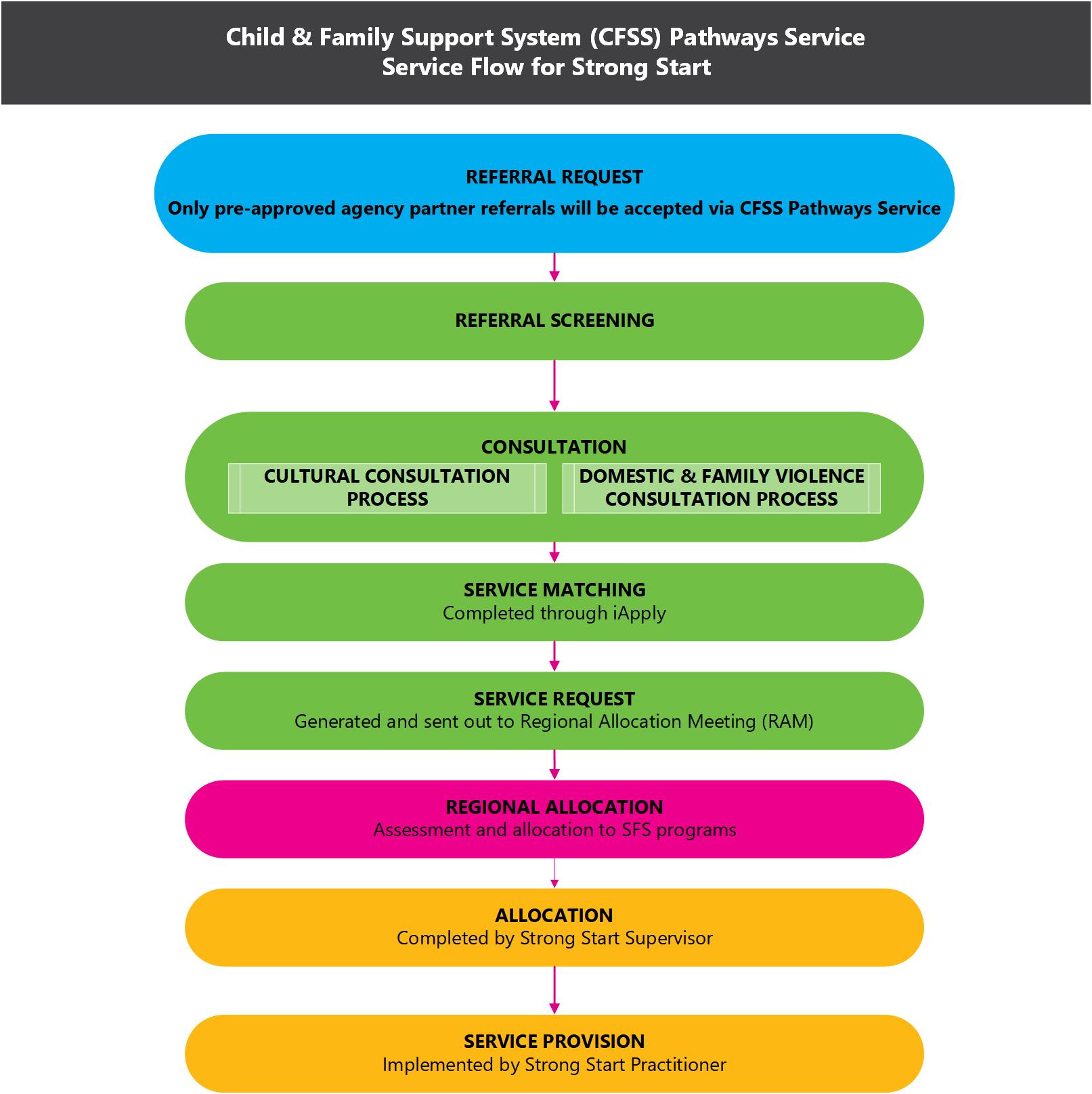
Plain text description of Strong Start Service Flow
Strong Start Flowchart
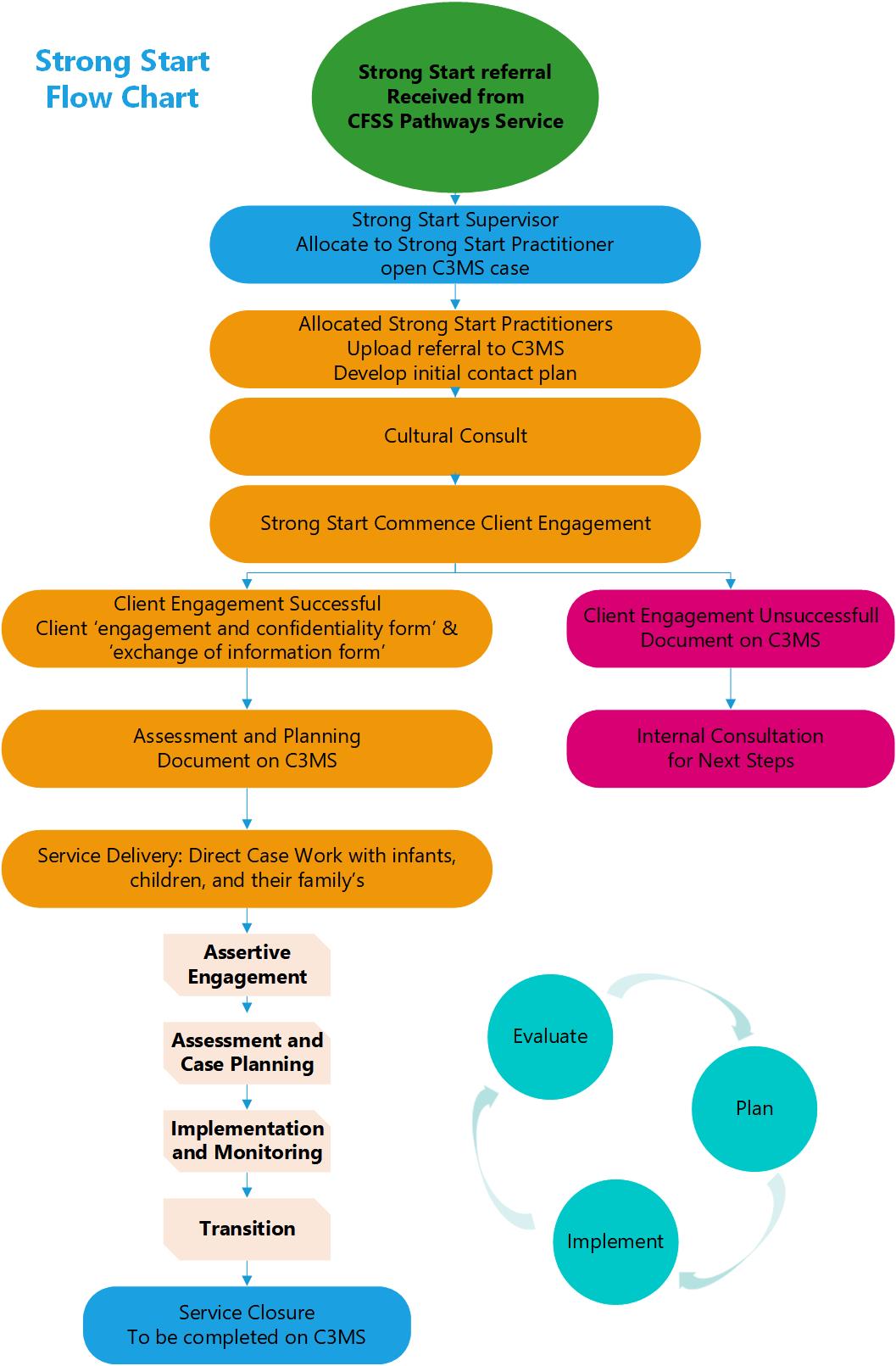
Plain text description of Strong Start Flowchart
Appendix A: Strong Start Program Logic
Inputs (resources)
Staffing
Multidisciplinary team comprising of:
- Registered Nurse 1 FTE
- Senior Play Educator 0.4 FTE
- Aboriginal Family Support Worker 1 FTE
- AHP1 Social Worker 3 FTE
- AHP2 Clinician 1 FTE
- AHP2 Senior Practitioner 1 FTE
- AHP3 Supervisor 1 FTE
- Administration Officer 1 FTE
Lived Experience
Strong Start grows and develops by respecting the lived experiences of the vulnerable families that we support, that being their parenting experiences and their experiences of being parented. This includes the parenting needs of our LBGTQIA community
Cultural
- Aboriginal and CALD team members
- Aboriginal, and CALD family and community members.
Partners
- Aboriginal Maternal Infant Care (AMIC)
- Allied Health Social Workers
- Anglicare Housing
- Birthing hospitals (Lyell McEwen, Women’s and Children’s, Gawler District)
- Centacare (Hannah Place/Malvern Place, Housing)
- Centrelink
- Child and Family Health Service (CaFHS)
- Children Centres (Dept. Ed.)
- Dept of Child Protection (DCP)
- Drug and Alcohol Services SA (DASSA)
- DV services
- HYPA Housing
- Multicultural Youth SA (MYSA)
- MY Health
- Northern Adelaide Senior College (NASC)
- NUNK (Nunkuwarrin Yunti)
- Perinatal Mental Health
- Playgroups SA
- SAPOL
Outputs
Activities/processes
Culturally responsive and trauma aware. Recognise and value, cultural knowledge, experience and authority, and that of Aboriginal and CALD families/communities we work with:
- Triage – initial assessment and allocation
- Warm referrals
- Home visits
- Cultural consultation
- Assessing - safety; risk (verbal); Ages and Stage questionnaire
- Linking (into services/supports)
- Safety planning
- Information sharing
- Transporting
- Attending appointments
- Case-conferencing
- Day-to-day conversations
- Discussions with family
- CARL notifications
- Gifts and baby goods – sourcing and delivering
- Common Elements
Participation
The target population is young pregnant women and first-time mums experiencing complex issues.
Voluntary and DCP motivated (families/clients)
Baby/child is the primary client.
Family-led discussions and engagement.
All meetings occur in the home or a safe space
Shared decision-making with family
Invite participation in the case management process – Assessment/ case planning/ Case review etc.
Outcomes - Short (0–3 months)
Mother
- Rapport established between mother and worker.
- Mother/family engage with worker/service
- Increased trust (mother - worker)
- Ante-natal needs met
- Increased housing stability
- Increased financial stability
- Increased parenting/child safety knowledge
- Acquire safe baby gear
- Drug and Alcohol harm minimization
- Link in with other support services (e.g domestic violence)
System
- Child protection concerns assessed
- Responses delivered within a holistic case plan approach.
- Appropriate referrals made to other service providers
- Increased family stability
- Work collaboratively with CFSN partners and handover cases where needed
- Increased stakeholder collaboration regarding decision making and sharing of risk
- Earlier engagement of families into services who may not have been otherwise engaged.
Outcomes - Medium (3–6 months)
Mother/baby
- Greater stability (in some cases)
- Better able to navigate difficulties
- Increased trust
- Increased understanding of the system
- Increased understanding of own agency
- Decreased fear of removal
- Increased understanding of ramifications of actions, leading to
- Increased engagement with support services
- Increased understanding of importance of contraception.
System
- Maintain good relationships with mother/family
- Able to have difficult conversations
- Improved communication channels
- Able to receive information regarding concerns
- Earlier notification re concerns
- Increased capacity of the stakeholder network to identity and respond to child protection concerns within their client base
- Increased skills and capacity of stakeholder network
- Stakeholder workforce have increased skill level to support effective responses in pre-statutory child protection work.
- Reduced duplication of services.
Outcomes - Long (6–12 months)
Child
- Receiving CaFHS checks every 3 months
- meeting developmental milestones
- Increased protective factors
- Receiving relevant allied health supports (physio/speech pathology)
- Safe at home
- Mother/family
- Greater stability
- Improved support networks
- Receiving ongoing support relevant to need
- Safety needs met
- Increased confidence to seek/access support
- Managing contraception
- Reduced risk of second pregnancy.
System
- Stakeholder network responds to child safety and protection concerns
- Agencies have up to date information.
- Agencies have access to consultation
- Earlier identification of infant’s needs and family strengths
- Coordinated service response
- Under ISG understand the need for strategic planning re child protection concerns.
Appendix B: Acronyms
ACCO
Aboriginal Community Controlled Organisation
ACCHO
Aboriginal Community Controlled Health Organisation
CARL
Child Abuse Report Line
CALD
Culturally and Linguistically Diverse
CFARN
Now called Safe Start
CFSN
Child and Family Safety Network
CFSS
Child and Family Support System
CPS
Child Protection Services
DCP
Department for Child Protection
DofE
Department for Education
DHS
Department of Human Services
DPC
Department of the Premier and Cabinet
EIRD
Early Intervention Research Directorate
EYT
Early Years Team
HRI
High-Risk Infant
MAPS
Multi-Agency Protection Service
SAPOL
South Australia Police
SFS
Safer Family Services
Appendix C: Glossary
Aboriginal
The term Aboriginal is respectfully used to refer to all Aboriginal and Torres Strait Islander people throughout this document.
Cultural capability
Cultural capability is a preferred term over ‘cultural competence’. Cultural capability does not suggest a competence in a culture other than one’s own but rather sets a standard for the extent of one’s ability to work from a cultural lens, incorporating the active practices of cultural awareness, cultural fitness and cultural humility, while actively implementing anti-racist practices.
Cultural fitness
A practice of applying oneself to the daily exercise of self-reflection, personal engagement, and active learning as they relate to reconciliation, cultural safety, white privilege, and valuing diversity.
Cultural humility
The reflective practice of acknowledging that the client is the expert in their own lives. This is done through the awareness of one’s own values, beliefs and privilege while also being actively aware of other cultures historical realities such as legacies of violence, oppression, discrimination, and trauma. Those who practice cultural humility view their clients as capable and work to understand their worldview encouraging a self-based process of lifelong learning.
Cultural Safety
Aims to directly address the effects of colonialism by focusing on the level of cultural safety felt by an individual when interacting with practitioners. Both an individual’s identity and culture are considered, and cultural safety needs to be applied at both the individual, environmental and organisational level.
Information Sharing Guidelines
The Information Sharing Guidelines for Promoting Safety and Wellbeing (ISG) provide a mechanism for information sharing when it is believed a person is at risk of harm (from others or as a result of their own actions) and adverse outcomes can be expected unless appropriate services are provided.
Intergenerational trauma
A term commonly associated with traumas inflicted on members of the Stolen Generations that is then passed down to future generations.
Practitioner
A practitioner is a worker who possess professional expertise, is skilled in the area of work and holds personal qualities that are suitable to the service delivery and clientele of the agency. The practitioner can undertake a variety of tasks within their duties, inclusive of undertaking information gathering, conducting comprehensive assessments, building relationships with families and support networks, developing robust case plans and working in.
Refer State Authority
Government departments and local councils are considered state authorities, as are any NGOs that receive funding from state or local government to provide services to young people and their families. If DCP determines that it is more appropriate for a state authority to respond to a child protection report, the report may be referred to that authority for a response. This must be done in agreement with the authority. Child protection notifications screened in as warranting an urgent (24hr) response cannot be referred.
Self-Determination
Refers to the rights of Aboriginal and Torres Strait Islander communities to hold choice and decision-making powers that lead to the active determination of their own social, political, economic, and cultural interests.
Transgenerational trauma
Occurs when grief and loss from one generation is passed to future generations
Warm referral
A joint home visit between DCP and SFS practitioners within the context of SFS accepting a referral made by DCP to the SFS program area under the outcome of ‘Refer State Authority’ (under the Children and Young People [Safety] Act 2017 [SA])
Warm transition
Supporting a client to transition from SFS to another service provider by contacting an agency prior to the client. This can include the sharing of information between SFS, the client and the agency, a joint home visit(s) or meeting, to ensure that the agency has received all the information that they require in order to accept the referral and provide the client with the services they require.
White privilege
White privilege can be defined as the implicit societal advantages afforded to white people, characterised by racial inequality and injustice. The privileges of whiteness generally go unnoticed by those that benefit from this system. It is important to understand white privilege and identify these inherent advantages in order to reject them so that they do not continue to reinforce our present hierarchies.